
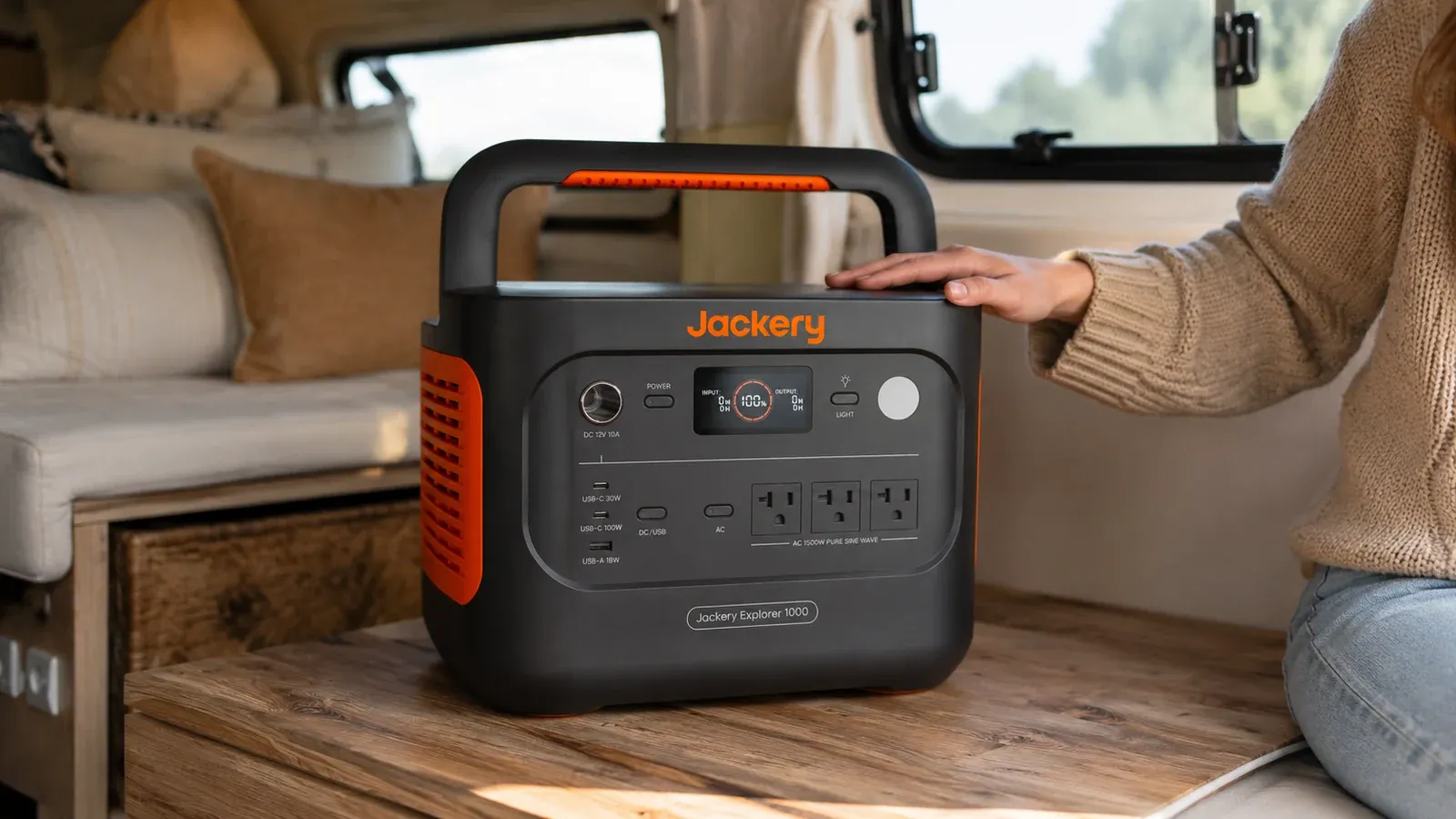
There are four LiFePO4 power stations worth considering in the 1,000Wh class in 2026: the Jackery Explorer 1000 v2, the Bluetti AC180, the Anker SOLIX C1000, and the EcoFlow Delta 2. They sit within a few percent of each other on usable capacity. They all carry five-year warranties. They all use the same battery chemistry. What separates them is how the four manufacturers chose to spend the available weight, inverter headroom, and solar input ceiling. The Jackery’s choices — lightest weight, fastest AC charge, lowest solar input — define a specific buyer. This review is about whether you are that buyer.
Who this is for
The Explorer 1000 v2 makes sense if at least two of these describe your use case:
- You move the unit between locations. Vehicle to campsite. Garage to RV. Home backup closet to a weekend trip. 23.8 pounds is the weight one person carries one-handed without thinking about it. Compared head-to-head with the 37-pound Bluetti AC180, the difference is the gap between “grab on the way out” and “find someone to help.”
- Your off-grid stays are mostly weekend-length. One to four nights, with AC recharge available before and after. Inside that window the Jackery refills fully overnight on shore power and asks nothing more of you.
- You need to power a CPAP, a 12V camp fridge, lights, and small electronics through the night. The unit’s continuous inverter is sized for exactly this class of load.
- You value the chemistry and warranty enough to pay a small premium over the Anker SOLIX C1000. The Anker is cheaper by enough to notice; the Jackery is lighter and a touch faster on AC, and you have to decide which matters more.
Who should skip it
Step away from this unit if either is true:
- You plan multi-week off-grid stays where solar is the primary recharge path. The 400W solar input ceiling caps your daily replenishment at roughly 280–320Wh of useful energy under realistic conditions. For a unit that has to live off-grid for two or three weeks, the Bluetti AC180’s 500W ceiling or stepping up to the 2,000Wh class is the better math. We cover that math in the Best Solar Generators for RVs roundup.
- You want sustained high-wattage resistive loads. Induction cooktops above 1,500W, hair dryers on high, electric kettles above 1,500W — the inverter trips at the threshold and there is no X-Boost-style voltage reduction to soft-handle the overage.
What changed from v1 — and why it matters
The original Jackery Explorer 1000 used NMC (lithium nickel manganese cobalt) cells rated for roughly 500 to 1,000 full cycles to 80% capacity. The v2 ships with LiFePO4 cells rated for 3,000+ cycles to the same threshold. Depending on how you count, that is a 3× to 6× increase in cell lifespan.
A v1 owner cycling the unit once a week was looking at 10 to 20 years before capacity dropped below 80%. A v2 owner is looking at 60+ years on the same cadence. In practice, the inverter, MPPT controller, or cooling fan will fail well before the cells degrade. The chemistry switch effectively removes battery degradation from the buying calculus.
Two secondary tradeoffs came with the switch:
- Weight went up. LiFePO4 cells are denser than NMC at the same capacity. The v1 weighed 22 lbs; the v2 is 23.8 lbs. Two pounds is the difference between a comfortable carry and a noticeable one over distance.
- Cold-weather charging stops at 32°F. LiFePO4 refuses to accept charge below freezing without permanent damage to the cells. Some manufacturers — Bluetti on specific models — add an integrated low-temperature heater that runs off battery capacity to keep cells charge-ready in winter. Jackery does not. For most users this is invisible. For winter campers expecting solar refill through a freezing morning, it is a real constraint.
Real capacity — what 1,070Wh means in practice
The 1,070Wh figure on the spec sheet is the cell-pack capacity. The number that matters for trip planning is the usable capacity at the AC outlets — what reaches your devices after the inverter loses energy converting DC to AC. For LiFePO4 units in this class, inverter efficiency typically lands in the 84% to 88% range.
That gives a planning capacity of roughly 900 to 940Wh at the AC outlets. For loads on the 12V output (skipping the inverter entirely), the picture is friendlier: 5% to 8% loss in the buck converter, leaving roughly 985 to 1,015Wh available.
Concrete runtime math on common loads, assuming a fresh, fully charged unit at room temperature:
| Load | Power | Output | Runtime |
|---|---|---|---|
| CPAP without humidifier | 35W | AC | ~26 hours |
| 12V camp fridge | 45W avg | 12V | ~22 hours |
| Mini fridge (cycling) | 90W avg | AC | ~10 hours |
| 65W USB-C laptop | 65W | USB-C | ~14 hours |
| Phone charging | 18W | USB-C | ~52 hrs charging |
| LED string lights | 12W | AC | ~75 hours |
| 700W microwave | 700W | AC | ~80 minutes |
| 900W coffee maker | 900W | AC | ~62 minutes |
| 1,200W hair dryer (high) | 1,200W | AC | ~45 minutes |
Two things to take from that table. First, on small continuous loads the unit is generous — a CPAP and a few lights last a full night with margin. Second, on high-wattage resistive loads the runtime collapses by physics, not by Jackery’s design. Any 1,000Wh-class unit spent at 1,000W is exhausted in under an hour, full stop.
Recharge
AC recharge is where the v2 visibly improves on the v1. With the included 1,200W AC adapter, the curve is:
- 0% to 80% in roughly 60 minutes
- 80% to 100% in another 40 minutes (the BMS throttles the top 20% to protect the cells from heat)
- Full charge: about 1.7 hours
That is competitive for the class. The EcoFlow Delta 2 still wins on AC charge speed (around 50 minutes to 80%), but the Jackery is meaningfully faster than the Bluetti AC180, which lands closer to 85 minutes to 80%.
The 12V vehicle path is in the realistic range. A 12V/10A car port delivers about 120W, recharging the unit from empty in roughly 7 hours of engine running — which means the morning departure, the long drive to the next stop, and the arrival with the unit at 70–80% state of charge is a normal workflow.
Solar recharge is where the 400W ceiling shows up. Paired with a single 200W foldable panel, full recharge from 20% takes 6 to 8 hours of unobstructed mid-day sun. A 200W panel is a good match — small enough to deploy easily, capable enough to refill the unit in a day. Pair the unit with two 200W panels and you hit the 400W ceiling, which means additional wattage past that point is wasted; the unit cannot accept more.
The inverter and surge behavior
The 1,500W continuous / 3,000W surge inverter handles the loads it is built for cleanly. A residential refrigerator compressor pulls 1,200 to 1,800W for the first half-second after startup, then settles to 100 to 200W continuous. The 3,000W surge headroom comfortably absorbs that. Sump pumps, well pumps, and small power tools sit in the same envelope.
Where the 1,500W continuous ceiling shows up: induction cooktops on high (typically 1,800W+) and portable electric heaters on high settings (often 1,500W) trip the inverter. Below 1,500W the unit is steady; above it the unit shuts off rather than attempt to deliver beyond rating. Unlike EcoFlow’s X-Boost mode, which reduces voltage to run higher-wattage resistive loads at reduced effective power, the Jackery has no equivalent. The 1,500W ceiling is a hard ceiling.
The 400W solar input ceiling — the spec that decides this purchase
Most reviews of the Explorer 1000 v2 lead with the weight or the cycle life and bury the solar input figure in a table. That framing buries the most consequential spec on the unit.
For weekend campers and tent users, 400W is plenty. You deploy 100 to 200W of panel, you camp two or three nights, you refill on AC at home. The ceiling is invisible because you never approach it.
For RV users and van-lifers expecting solar to do real work, 400W is a meaningful constraint. The arithmetic: a 400W panel array under realistic mid-day conditions delivers about 280–320W of useful charging once you account for panel angle, partial shade, MPPT efficiency, and dust on the panels. That works out to about 2,000 to 2,500Wh per day of solar input under good conditions — enough to fully refill the unit and run light evening loads, but not enough headroom to keep up with sustained daily use of a fridge plus electronics plus a CPAP overnight without a cloudy day in the mix.
The Bluetti AC180 raises the ceiling to 500W. The Anker SOLIX C1000 raises it to 600W. The math, summarized: if your scenario is two-plus weeks off-grid with daily solar refill, the AC180 or C1000 buys you 25% to 50% more daily headroom for similar money. If your scenario is two-night camping trips with AC recharge before and after, the ceiling is irrelevant and the lighter Jackery is the smarter choice.
Build, ports, noise
The case is impact-resistant plastic with a fold-down handle that locks at both ends and is rated to hold the full unit weight by either side. The display is a high-contrast LCD with a backlight — readable in direct sun, readable in a dark tent. State of charge, output watts, input watts, and a runtime estimate are all on-screen at once.
Port layout:
- 3 × AC outlets (1,500W combined, pure sine wave)
- 2 × USB-C (one rated 100W PD, one rated 18W)
- 2 × USB-A
- 1 × 12V/10A cigarette port (regulated)
- 1 × DC input for AC charging
- 1 × DC input for solar charging (8mm, with MC4 adapter cable included)
Three AC outlets is enough for a CPAP, a lamp, and a fan or laptop charger — the typical weekend load. For home backup with several devices, plan to add a small power strip extension.
Cooling fan noise sits at roughly 45 dB at one meter under a 50% rated AC load. That is quieter than the EcoFlow Delta 2 under the same load (closer to 53 dB) and noticeably louder than the Bluetti AC180 at idle. The fan operates on a thermostatic curve: under light loads, the unit is close to silent.
Cold-weather behavior
LiFePO4 chemistry stops accepting a charge below 32°F (0°C) and degrades faster above 113°F (45°C). The Explorer 1000 v2 has no integrated heater. If the unit cold-soaks overnight in an unheated truck bed or an external RV storage bay during a freezing night, solar charging will not start until the cells warm to operating temperature — typically by mid-morning under direct sun, longer in shade.
Discharge behavior in cold is more forgiving. The unit delivers usable power down to about 0°F, with available capacity dropping 10% to 20% in the cold. For winter camping, the practical guidance is straightforward: keep the unit inside the rig overnight rather than in an external storage compartment, and expect slower morning solar recharge if temperatures dipped below freezing.
How it compares
The Explorer 1000 v2 lives in a tight neighborhood. Four LiFePO4 units, all roughly within 10% of each other on the major specs, all carrying five-year warranties. The differences are quiet but consequential.
| Spec | Jackery 1000 v2 | Bluetti AC180 | Anker SOLIX C1000 | EcoFlow Delta 2 |
|---|---|---|---|---|
| Capacity (Wh) | 1,070 | 1,152 | 1,056 | 1,024 |
| Continuous inverter | 1,500W | 1,800W | 1,800W | 1,800W |
| Surge | 3,000W | 2,700W | 2,400W | 2,700W |
| AC charge to 100% | ~1.7 hrs | ~1.8 hrs | ~58 min | ~1.3 hrs |
| Solar input max | 400W | 500W | 600W | 500W |
| Weight | 23.8 lbs | 37 lbs | 28.4 lbs | 27 lbs |
| Warranty | 5 yrs | 5 yrs | 5 yrs | 5 yrs |
| Chemistry | LiFePO4 | LiFePO4 | LiFePO4 | LiFePO4 |
| Expansion battery | No | No | Yes | Yes |
Buy the Explorer 1000 v2 if weight is in your top three buying criteria. Nothing else in the class is this light. Buy it also if you value the strongest surge handling here — the 3,000W surge edges out the others by 300 to 600W, which matters at the moment a fridge or sump pump kicks on.
Buy the Bluetti AC180 if you want more capacity, more solar input, and a stronger continuous inverter, and you accept 13 extra pounds. For home backup specifically — see our home backup guide — the AC180’s combination of capacity and inverter headroom is the better match.
Buy the Anker SOLIX C1000 if price is the primary filter. It is consistently the cheapest of the four, charges fastest on AC, and has the highest solar input. The 2,400W surge is the only meaningful give-up.
Buy the EcoFlow Delta 2 if you might want expansion batteries later, or if X-Boost (running 2,200W resistive loads via voltage reduction) is relevant to your kitchen.
Final verdict
The Jackery Explorer 1000 v2 is the right unit for buyers who actually carry their power station. Campers who move it between trunk and tent. Van-lifers without a built-in lithium system. Homeowners who want a backup unit that lives in a closet and comes out once a year and once a year only. The chemistry switch makes the unit dependable for 20+ years of normal use. The 1,200W AC charging makes it practical for “ran low yesterday, full again before dinner” cadence. The 23.8-pound weight makes it the easiest unit to actually use in this class.
The 400W solar input ceiling is the spec that disqualifies it for multi-week off-grid scenarios where solar is the primary refill path. If that is your trip, step sideways to the Bluetti AC180, or up to the 2,000Wh class — the RV solar generators roundup lays out the options in that range. For everyone else inside the weekend-to-long-weekend window, this is the unit.