ROUNDUP
Independent reviews of the units that actually keep your home running when the grid goes down.
Last updated
The most demanding thing you can ask a portable power station to do is back up a house. Refrigerators kick on and off at random. Sump pumps need a 1,500-watt surge for half a second before they settle into a 300-watt draw. A laser printer can pull 1,000 watts every time it warms up. If your unit can't handle those spikes, it shuts off — and shutting off in the middle of an outage is the entire problem you were trying to avoid.
Home backup is also the use case where capacity matters most. A 24-hour outage at a modest 200-watt average draw is 4,800 watt-hours. Plenty of well-reviewed "1,000Wh" power stations don't have the headroom to make it through a single winter night.
Portable power stations make sense for home backup in three scenarios:
If you're trying to back up an entire house including HVAC, you're not in the right category. A transfer switch and a permanently installed standby generator are the right tools for that job.
The watt-hour figure printed on the side of a power station is the nameplate capacity of the cells inside. The number that matters is the usable capacity at the AC outlets — typically 10% to 25% lower because the inverter loses energy converting DC to AC. Our reviews report the measured number, not the nameplate.
Refrigerator compressors, sump pumps, and well pumps all draw two to five times their running wattage for the first half-second after starting. A power station with an "1,800W continuous, 3,600W surge" inverter is what you want for those loads. Below 3,000W surge, expect random shutoffs.
When the grid comes back, you want the unit topped up before the next outage. Look for AC charge rates of at least 1,000W on a 2,000Wh unit — anything slower means you might still be charging when the next storm rolls in. Many units also throttle in the last 20% to protect the cells; we measure and report that.
Even if you're not buying solar panels today, the solar input rating sets the ceiling on how off-grid this unit can take you later. 400W of solar input is the entry-level useful number; 800–1,200W gets you into "this station can charge faster than my house draws" territory.
LiFePO4 (lithium iron phosphate) is the chemistry to want for home backup. It cycles 3,000–6,000 times to 80% capacity (versus 500–1,000 for older NMC lithium), tolerates heat better, and is not a fire risk. Most serious current models use LiFePO4 — but check.
Look at the AC outlet count (you want at least four for serious backup), USB-C with 100W output (laptops), and a regulated 12V output. "Pass-through" means you can use the station while it is charging — non-negotiable for backup.
A portable power station is the right choice when you want quiet, indoor-safe, zero-maintenance backup for the essentials. It is the wrong choice if you need to run central air conditioning, electric ovens, or a well pump for days at a time — those need a 7–22kW standby generator with a transfer switch, which is a different category of purchase entirely. A gas generator sits between the two: louder, fuel-dependent, but capable of running an entire house intermittently.
The major 2,000–4,000Wh units from EcoFlow, Jackery, Bluetti, and Anker SOLIX are the core of the home backup market. Our testing focuses on:
See our full testing methodology for the details. Reviews of individual models will appear on this page as they're published.
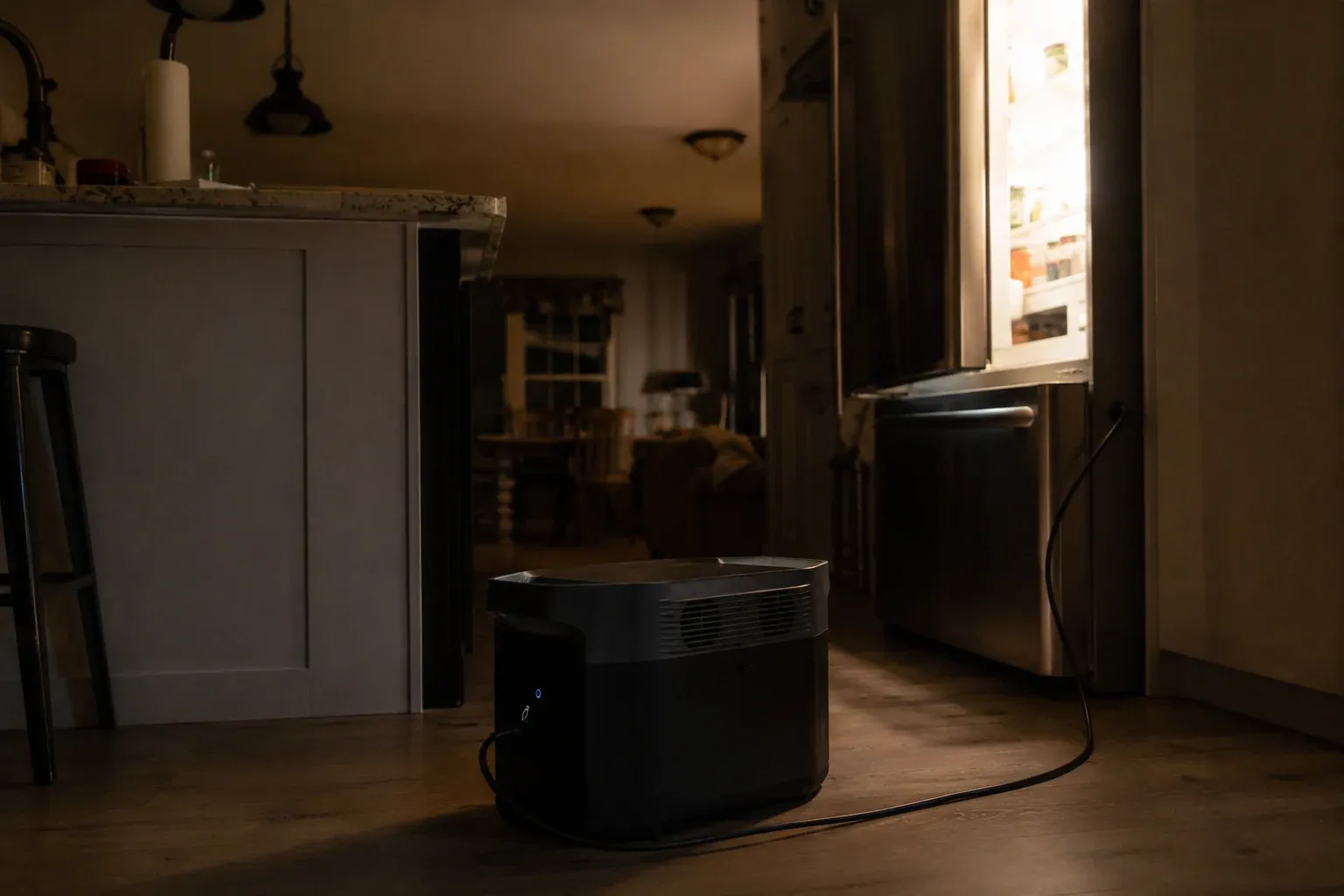
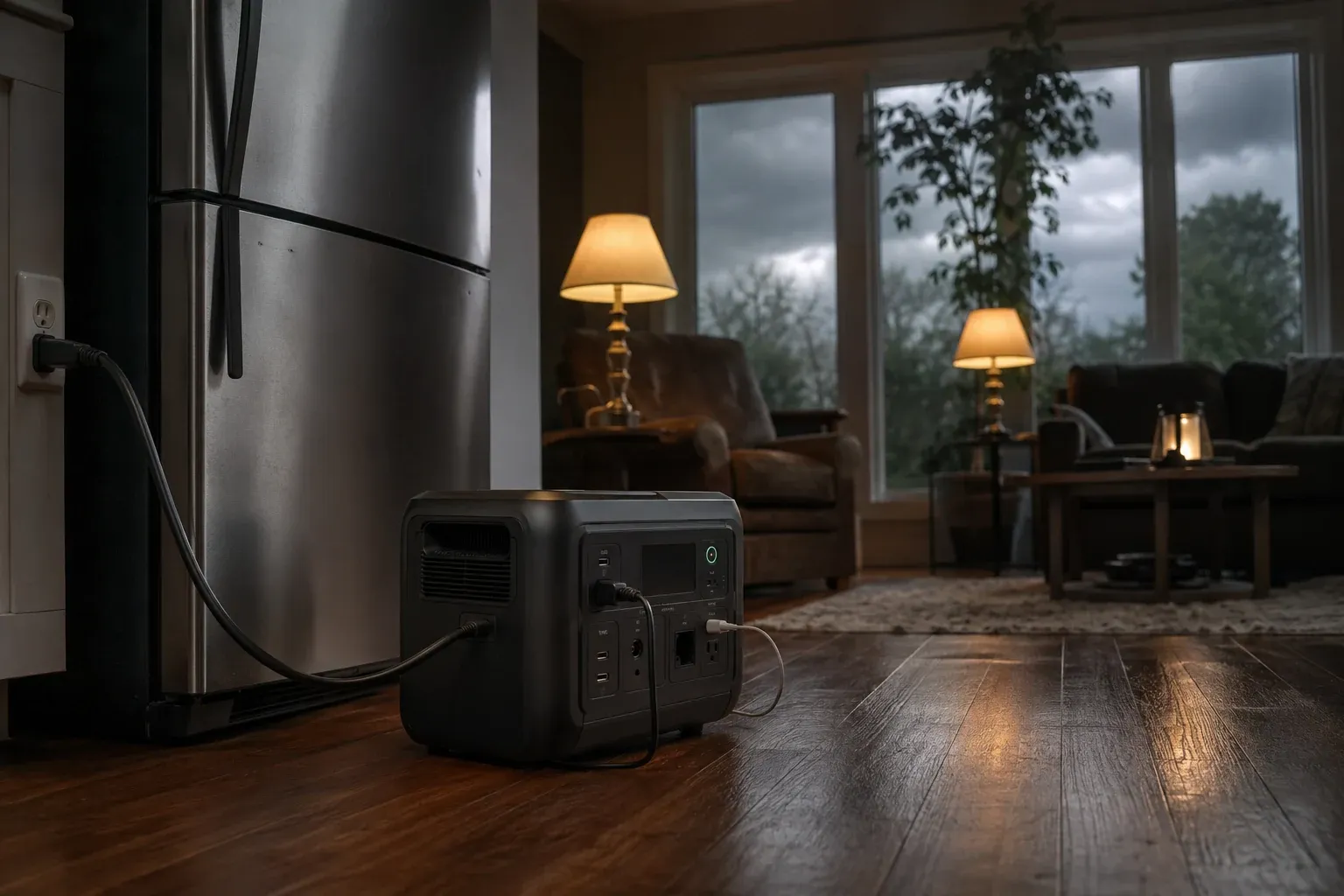
A modern energy-efficient refrigerator averages roughly 140W when it cycles on. A 2,000Wh power station with around 85% usable capacity (1,700Wh) will run that fridge for about 12 hours before it needs recharging — assuming nothing else is connected. Larger 4,000Wh units roughly double that.
For a short outage covering essentials (fridge, lights, internet, phones), 1,500–2,000Wh of usable capacity is the practical minimum. For multi-day outages including a CPAP and small electronics, 3,000–5,000Wh is more realistic. Pair with solar if outages can extend past 24 hours.
No. Even the largest 4,000Wh portable units cannot run central air conditioning, an electric water heater, or an electric range. Portable power stations are for backing up essentials — fridges, lights, internet, small electronics, medical devices. Whole-home backup requires a permanently installed standby generator or a home battery system.
Yes. Unlike gas generators, portable power stations produce no exhaust and run safely inside the house. The only practical consideration is fan noise — some units get loud during high-load discharge, which can be unwelcome in a bedroom but is otherwise safe.
A LiFePO4 power station kept at 50–80% state of charge in a room-temperature environment will hold its charge for six months to a year between top-ups. We recommend topping up every three months and never letting a stored unit drop below 20%.