
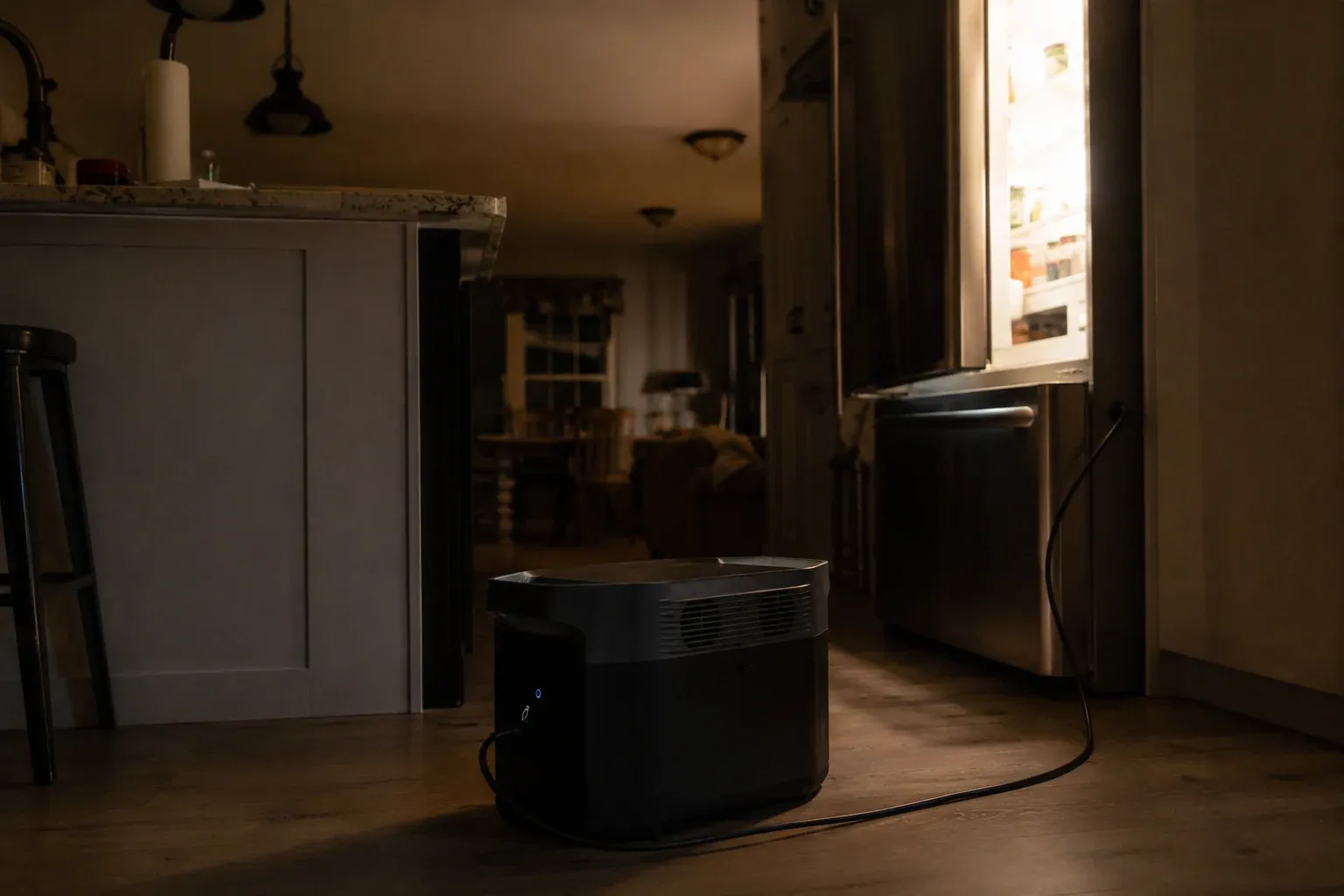
Yes. A portable power station can run a refrigerator — the real question is for how long. A 1,000Wh station runs a typical residential fridge for 10 to 15 hours; a 2,000Wh unit roughly doubles that. The number surprises people because a fridge compressor does not run continuously. It cycles on and off, drawing its rated wattage only 30 to 50 percent of the time. Get that one fact right and the math stops being intimidating.
The two numbers on your fridge that matter
Every refrigerator has two power figures, and they do different jobs:
- Running watts — what the compressor draws while it is actively cooling. For a standard residential fridge this is 100 to 200W. It is usually printed on the nameplate inside the door, or on the energy guide label, and it is the number that determines runtime.
- Surge watts — the spike the compressor pulls for about half a second at the instant it starts, before it settles into its running draw. This runs 2 to 3 times the running figure: a fridge that runs at 150W can spike to 1,000–1,800W on startup. This is the number that determines whether the station can start the fridge at all.
Both matter, and they fail in different ways. Too little capacity and the fridge runs but the battery dies early. Too little surge headroom and the station shuts off the moment the compressor kicks on — runtime never even becomes the question.
The mistake everyone makes: a fridge is not always running
Here is the math that trips people up. Take a fridge with a 150W running draw. The naive calculation says a 1,000Wh station runs it for 1,000 ÷ 150 = 6.7 hours. That number is wrong, and it is wrong by a factor of two or more.
A refrigerator compressor does not run constantly. It runs until the interior hits the set temperature, shuts off, and stays off until the temperature drifts back up. Over a full hour, a typical fridge compressor is actually running 30 to 50 percent of the time — a figure called the duty cycle. So a fridge with a 150W running draw averages roughly 50 to 75W over an actual hour of operation.
Redo the math with the duty cycle and a 1,000Wh station (call it 850Wh usable after inverter losses) runs that fridge for 850 ÷ 65 ≈ 13 hours, not 6.7. This is why real-world runtime is roughly double what the nameplate-times-hours calculation predicts. The duty cycle is also why a slightly fuller fridge runs more efficiently: the cold mass inside holds temperature longer between compressor cycles.
How long a power station actually runs a fridge
Putting the duty cycle into practice, here is realistic runtime by station capacity and fridge type, assuming a closed door and normal ambient temperature:
| Fridge type | Avg draw (with duty cycle) | 1,000Wh station | 2,000Wh station |
|---|---|---|---|
| Mini fridge | ~30W | ~28 hours | ~55 hours |
| Energy-efficient residential | ~55W | ~15 hours | ~30 hours |
| Large french-door | ~75W | ~11 hours | ~22 hours |
| Chest freezer | ~50W | ~17 hours | ~34 hours |
| 12V RV / camp fridge | ~45W (on 12V) | ~21 hours | ~42 hours |
Two takeaways. First, even a modest 1,000Wh station covers a full overnight outage for most fridges. Second, the 12V camp fridge gets noticeably more runtime because it skips the inverter entirely — running on the station’s 12V output avoids the 10–15% conversion loss the AC outlets carry.
What different fridges actually draw
The “running watts” figure varies more than people expect. As a reference for sizing:
| Appliance | Running watts | Typical surge |
|---|---|---|
| Mini fridge (1.7–4.5 cu ft) | 50–90W | 200–400W |
| Standard top-freezer | 100–150W | 600–1,200W |
| Large french-door / smart fridge | 150–250W | 1,200–1,800W |
| Upright or chest freezer | 80–120W | 800–1,500W |
| 12V RV compressor fridge | 40–60W | 100–200W |
If you do not know your fridge’s draw, a $15 plug-in energy meter measures it directly over a day and removes the guesswork. Measuring beats the nameplate, which often lists a worst-case figure higher than real operation.
The surge problem — and how to avoid it
The single most common failure when running a fridge on a power station is the inverter cutting out at the moment the compressor starts. The compressor’s startup spike is brief but large, and an undersized inverter protects itself by shutting down rather than trying to deliver beyond its rating.
The fix is to read the station’s surge rating, not just its continuous rating. A station listed at “1,800W continuous, 2,700W surge” handles a residential fridge: the 2,700W surge clears the 1,200–1,800W startup spike, then the fridge settles into 150W, well under the 1,800W continuous limit. Units with surge ratings below about 2,000W are a gamble with larger fridges. The Jackery Explorer 1000 v2, for example, pairs a 1,500W continuous inverter with a 3,000W surge specifically so it can start compressor loads its continuous rating alone would suggest it can’t.
What size station you need for outage backup
Work backward from how long the power typically stays out where you live:
- A few hours to overnight: A 1,000Wh station with a 2,700W+ surge covers the fridge with room for phone charging and a lamp. The cheapest viable insurance.
- A full 24-hour outage: Size for 1,500–2,000Wh so the fridge runs through the day and night with margin, and you can add a router or a CPAP.
- Multi-day outages: A 2,000Wh+ station paired with solar. The battery bridges the gap; the panels refill it. This is the only configuration that lasts beyond a day or two.
Our home backup section covers the full sizing picture, and the solar panel pairing guide handles the recharge side. Every figure here follows our testing methodology.
Running a fridge indefinitely with solar
If outages in your area can run for days, battery alone is not the answer — solar is. A residential fridge consumes roughly 1,000 to 1,500Wh over a full day once the duty cycle is accounted for. Replacing that takes 200 to 400W of solar panels, which return about 60 to 75 percent of their rating in real conditions. On a sunny day that array refills the station faster than the fridge drains it, leaving a surplus for evening loads. The station carries the fridge overnight; the sun refills it by noon. Pair the two and the fridge runs as long as the weather cooperates.
Recommended stations for fridge backup
The right unit depends on outage length. For overnight coverage, a capable 1,000Wh unit is enough; for 24-hour-plus, step up:
- The Bluetti AC180 — 1,152Wh with a 2,700W surge that starts a residential fridge cleanly. A strong single-outage backup.
- The Bluetti AC200L — 2,048Wh, expandable, with the headroom for a fridge plus a freezer and a 1,200W solar input for multi-day outages.
- The EcoFlow Delta 2 Max — 2,048Wh with fast recharge for when the grid blinks back and you want to top up before the next outage.
The short version
A portable power station runs a refrigerator without trouble, and longer than the nameplate math suggests — because the compressor only runs 30 to 50 percent of the time. A 1,000Wh station covers most fridges for 10 to 15 hours; 2,000Wh doubles it. Check the surge rating clears the compressor’s startup spike, keep the door closed, and add solar if your outages run past a day. Sized right, the fridge is the last thing you’ll worry about when the grid goes down.