The short answer
For most RVers and van-lifers shopping in 2026, the Bluetti AC180 is the right unit — 1,152Wh of LiFePO4 capacity, a 1,800W inverter that handles real-world appliance startups, a 500W solar input that pairs cleanly with two 200W panels, and a five-year warranty that the cheaper alternatives don't match. It is the unit that asks the fewest questions of its owner.
If portability matters more than capacity, the Jackery Explorer 1000 v2 at 23.8 pounds is the lightest LiFePO4 unit in its class. For multi-week boondocking with real loads, step up to the Bluetti AC200L (expandable to 8,192Wh) or the Jackery Explorer 2000 v2 (lightest 2,000Wh unit). For full-time off-grid living with a rooftop air conditioner in the picture, the EcoFlow Delta Pro is the only unit here in a different category of capability.
Top picks at a glance
- Best Overall for RVs: Bluetti AC180
- Best Lightweight: Jackery Explorer 1000 v2
- Best All-Around: EcoFlow Delta 2
- Best Value: Anker SOLIX C1000
- Best for Heavy AC Loads: Bluetti AC200L
- Best for Multi-Week Boondocking: Jackery Explorer 2000 v2
- Best Expandable: EcoFlow Delta 2 Max
- Best for Full-Time Off-Grid: EcoFlow Delta Pro
Comparison table
| Unit | Capacity | Inverter | Solar in | Weight |
|---|---|---|---|---|
| Bluetti AC180 | 1,152 Wh | 1,800 W continuous | 500 W max | 37 lbs |
| Jackery Explorer 1000 v2 | 1,070 Wh | 1,500 W continuous | 400 W max | 23.8 lbs |
| EcoFlow Delta 2 | 1,024 Wh | 1,800 W continuous | 500 W max | 27 lbs |
| Anker SOLIX C1000 | 1,056 Wh | 1,800 W continuous | 600 W max | 28.4 lbs |
| Bluetti AC200L | 2,048 Wh | 2,400 W continuous | 1,200 W max | 62 lbs |
| Jackery Explorer 2000 v2 | 2,042 Wh | 2,200 W continuous | 1,400 W max | 39.7 lbs |
| EcoFlow Delta 2 Max | 2,048 Wh | 2,400 W continuous | 1,000 W max | 50 lbs |
| EcoFlow Delta Pro | 3,600 Wh | 3,600 W continuous | 1,600 W max | 99 lbs |
Best Overall for RVs
Bluetti AC180
The Bluetti AC180 sits exactly where most RVers want to be: enough capacity for a long weekend, enough inverter to start a residential fridge, and enough solar input to actually keep the unit topped up between stops. It is the unit that asks the fewest questions of its owner.
- Capacity
- 1,152 Wh (LiFePO4)
- Inverter
- 1,800 W continuous · 2,700 W surge
- Solar input
- 500 W max
- Weight
- 37 lbs
- Warranty
- 5 years
Why it works for RV use
What makes it work for RV use is the regulated 12V output rated at 10A — it powers a 12V fridge or fan directly without converter losses — paired with a 500W solar input ceiling that is large enough for two real-world 200W portable panels. The pure sine wave inverter handles compressor surges that trip cheaper units, and pass-through charging lets you leave it plugged into shore power without giving up the AC outlets.
Pros
- Strong 500W solar input with a wide 12–60V MPPT range
- Regulated 12V output rated at 10A
- Quiet under typical RV loads (≈45 dB at 50% draw)
- LiFePO4 cells rated 3,500+ cycles to 80%
- 5-year warranty (industry-best for this tier)
Cons
- AC charging tops out at 1,440W — slower than the EcoFlow Delta 2
- No app or remote monitoring
- At 37 lbs it is heavier than the Jackery Explorer 1000 v2
The bottom line: If you want one unit to recommend to someone shopping for an RV power station this year, this is it. The AC180 is not the lightest, the fastest, or the biggest — it is the one that handles the most real-world RV scenarios without compromise.
Check price on Amazon →Best Lightweight Pick
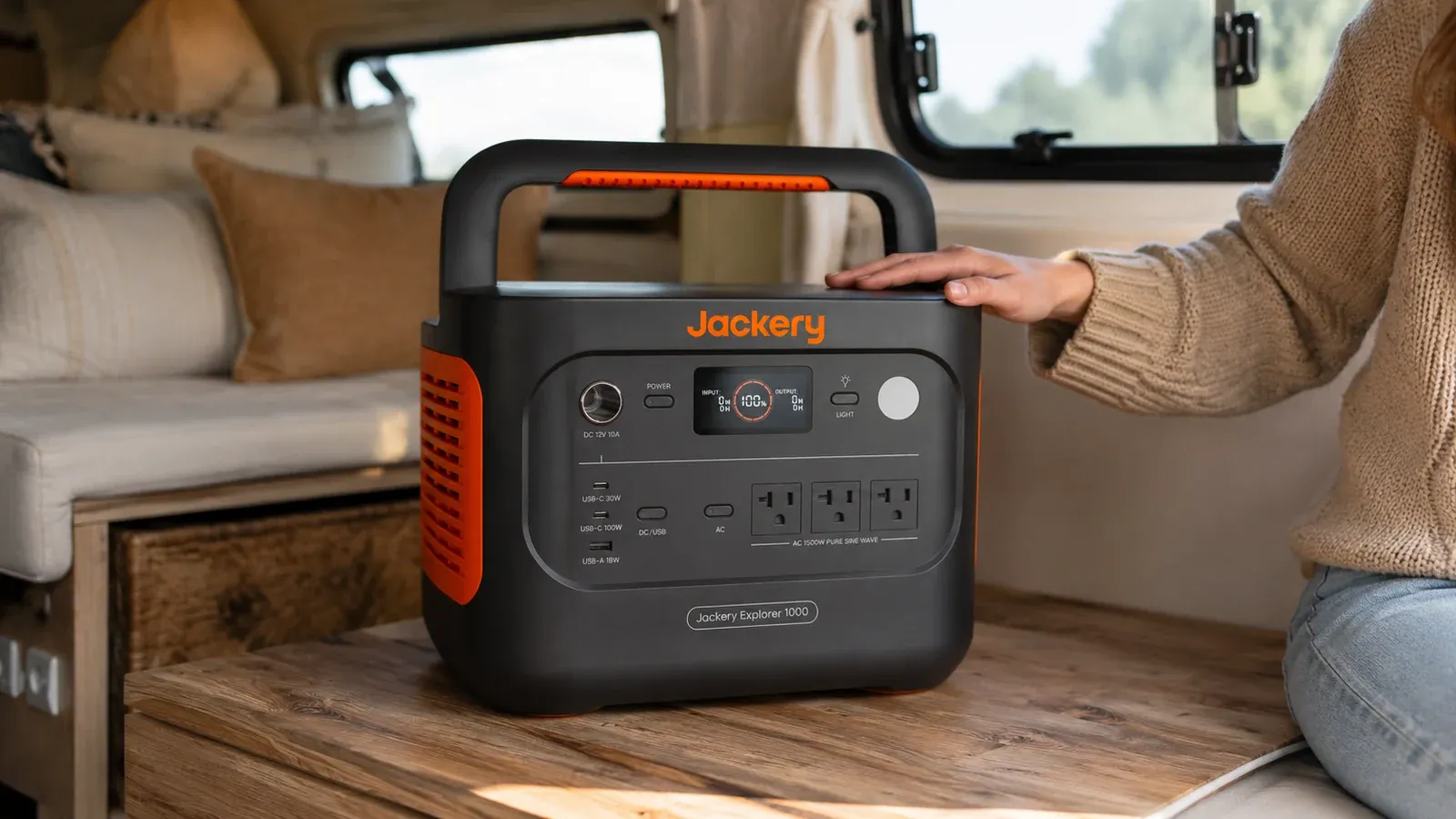
Jackery Explorer 1000 v2
The second-generation Explorer 1000 dropped the older NMC cells in favor of LiFePO4 and shed weight in the process. At 23.8 pounds it is the most carry-able unit in this roundup — meaningful if you are loading a van every weekend or running the unit between a tent and a vehicle.
- Capacity
- 1,070 Wh (LiFePO4)
- Inverter
- 1,500 W continuous · 3,000 W surge
- Solar input
- 400 W max
- Weight
- 23.8 lbs
- Warranty
- 5 years
Why it works for RV use
Light enough to live in the front passenger footwell, capacity that covers a CPAP, lights, and a 12V fridge for a long weekend, and a 3,000W surge that comfortably starts a small residential compressor. The 400W solar input ceiling is the only obvious limit — pair this unit with a single 200W panel and accept that recharge time on a cloudy day will be slow.
Pros
- Lightest LiFePO4 unit in its capacity class (23.8 lbs)
- Strong 3,000W surge rating despite modest continuous output
- Jackery app gives a clean charge-state and runtime read
- 5-year warranty
- Quiet at idle — close to silent in 12V-only mode
Cons
- 400W solar input ceiling limits multi-week off-grid use
- Inverter peaks at 1,500W continuous — no high-draw appliances
- Premium price for the capacity compared to Bluetti
The bottom line: The right choice if you carry the unit a lot or split it between an RV and a tent setup. If it lives in one place inside the rig, the Bluetti AC180 is the smarter buy.
Check price on Amazon →Best All-Around for Versatile Use
EcoFlow Delta 2
The Delta 2 is the most copied power station in this category, and for reason — EcoFlow set the template for fast AC charging (0–80% in roughly 50 minutes), expandable capacity, and an app that actually helps. It is also the unit that converts other brands' loyalists.
- Capacity
- 1,024 Wh (LiFePO4, expandable to 3,040 Wh)
- Inverter
- 1,800 W continuous · 2,700 W surge (X-Boost to 2,200 W)
- Solar input
- 500 W max
- Weight
- 27 lbs
- Warranty
- 5 years
Why it works for RV use
X-Boost is the underrated feature: it lets the inverter run resistive loads up to 2,200W (kettles, low-power induction cooktops) by reducing the voltage delivered, which is a useful capability in a galley. Expansion batteries take this unit up to 3,040Wh without changing rigs. The 500W solar input plus an EcoFlow Smart Generator pairing covers extended boondocking.
Pros
- Industry-leading AC charging speed (1,200W in)
- Expandable to 3,040Wh with additional batteries
- X-Boost mode runs resistive loads up to 2,200W
- Robust app and remote monitoring over Wi-Fi
- 5-year warranty
Cons
- Fan can spin up audibly under sustained high AC discharge (≈53 dB)
- Slightly less RV-friendly 12V output regulation than the Bluetti
- EcoFlow promo pricing fluctuates — pay attention before checkout
The bottom line: Pick the Delta 2 if your use case is mixed — RV weekends, home backup, the occasional emergency. The expansion path matters more than the marginal capacity bump.
Check price on Amazon →Best Value
Anker SOLIX C1000
Anker arrived late to the portable power category and proceeded to undercut the established brands. The SOLIX C1000 is the clearest example — capacity and inverter on par with the Bluetti AC180, a higher solar input ceiling, and a price that is reliably the lowest of the four.
- Capacity
- 1,056 Wh (LiFePO4)
- Inverter
- 1,800 W continuous · 2,400 W surge
- Solar input
- 600 W max
- Weight
- 28.4 lbs
- Warranty
- 5 years
Why it works for RV use
For an RVer building a system from scratch on a budget, the C1000 is a sensible anchor. The 600W solar input is higher than anything else in this bracket, which means you can grow into a larger panel array without changing the unit. The trade-off is a slightly lower surge rating — 2,400W versus the AC180's 2,700W — which can matter for some residential fridge compressors.
Pros
- Best price-to-capacity ratio in the 1,000Wh bracket
- 600W solar input — highest in this size class
- UltraFast AC charging (≈58 min to 100%)
- LiFePO4 cells, 5-year warranty
- Compact for the capacity (smaller footprint than the AC180)
Cons
- 2,400W surge can trip on some larger compressor startups
- App is functional but less polished than EcoFlow or Jackery
- Anker's portable solar panel pricing is less competitive than the unit itself
The bottom line: If price is the primary filter, the SOLIX C1000 wins this roundup outright. The Bluetti AC180 is the safer pick for surge-heavy loads, but the C1000 covers 90% of RV scenarios at a meaningful discount.
Check price on Amazon →Best for Heavy AC Loads
Bluetti AC200L
When the loads start including a rooftop air conditioner, a residential refrigerator, or an electric kettle in series, the 1,000Wh class runs out of room. The AC200L is the natural step up — twice the capacity, a 2,400W continuous inverter that handles real AC startup demands, and a 1,200W solar input that keeps the system off-grid indefinitely with a panel array to match.
- Capacity
- 2,048 Wh (LiFePO4, expandable to 8,192 Wh)
- Inverter
- 2,400 W continuous · 3,600 W surge (Power Lifting to 3,600W resistive)
- Solar input
- 1,200 W max
- Weight
- 62 lbs
- Warranty
- 5 years
Why it works for RV use
For full-time RVers, this is where the math starts working without compromise. The Power Lifting mode runs resistive loads up to 3,600W by voltage reduction. Eight expansion batteries can take it to 8,192Wh — overkill for most, but useful for fifth-wheels and trailers with serious electrical demand.
Pros
- 2,400W continuous inverter handles RV-AC startup with a soft-start kit
- Expandable to 8,192Wh via add-on batteries
- 1,200W solar input with a wide MPPT range
- 5-year warranty
- Wheels and pull handle on the unit make 62 lbs manageable
Cons
- 62 lbs is heavy enough to require two hands and planning
- Premium price — typically $1,400–1,800 at full retail
- Fan ramp under heavy AC load is louder than the AC180
The bottom line: The serious-RVer choice. Pick this when your loads exceed the 1,000Wh class and you want the option to grow capacity without replacing the unit.
Check price on Amazon →Best for Multi-Week Boondocking
Jackery Explorer 2000 v2
Jackery's second-generation 2000Wh unit dropped 25 pounds compared to the original — a significant change for anyone actually moving the unit between vehicle and campsite. It is the lightest 2,000Wh unit in this roundup.
- Capacity
- 2,042 Wh (LiFePO4)
- Inverter
- 2,200 W continuous · 4,400 W surge
- Solar input
- 1,400 W max
- Weight
- 39.7 lbs
- Warranty
- 5 years
Why it works for RV use
The combination matters: 2,000Wh of capacity, a 4,400W surge that starts almost anything, a 1,400W solar input that handles three 400W panels, and 39.7 lbs of carry weight. For boondockers who run a refrigerator, lights, fans, and devices for a week at a time with solar recharge during the day, this is the most balanced unit in this size class.
Pros
- Lightest 2,000Wh class unit by a meaningful margin (39.7 lbs)
- 4,400W surge handles RV-AC start with a soft-start kit
- 1,400W solar input — strongest in its class
- Quiet operation under typical multi-day loads
- 5-year warranty
Cons
- No expansion battery option — fixed at 2,042Wh
- Premium price tracks the Bluetti AC200L
- Slower AC charging than the EcoFlow Delta 2 Max
The bottom line: Best in class if you actually move the unit. If it lives in the rig permanently, the AC200L expansion path is worth considering.
Check price on Amazon →Best Expandable System
EcoFlow Delta 2 Max
EcoFlow took the Delta 2 formula and scaled it. The Delta 2 Max keeps the fast charging, the X-Boost mode, and the app, and adds enough capacity to run a refrigerator overnight without thinking about it.
- Capacity
- 2,048 Wh (LiFePO4, expandable to 6,144 Wh)
- Inverter
- 2,400 W continuous · 3,400 W surge (X-Boost to 3,100 W)
- Solar input
- 1,000 W max
- Weight
- 50 lbs
- Warranty
- 5 years
Why it works for RV use
Expansion is the headline. Adding two Delta 2 Max smart extra batteries takes the system to 6,144Wh — enough for indefinite off-grid stays paired with adequate solar. The 1,000W solar input is lower than the Jackery 2000 v2's 1,400W, but the AC charging speed (≈1.1 hours to 100%) is class-leading.
Pros
- Expandable to 6,144Wh via two extra batteries
- X-Boost runs resistive loads up to 3,100W
- Fast AC charging — 0–100% in about 1.1 hours
- Best-in-class EcoFlow app
- 5-year warranty
Cons
- Solar input ceiling (1,000W) lower than the Jackery 2000 v2
- 50 lbs without the wheels of the AC200L makes it awkward to move
- EcoFlow pricing is volatile — wait for a sale
The bottom line: The right choice if you want to start with one unit and grow into a larger system without changing platforms.
Check price on Amazon →Best for Full-Time Off-Grid Living
EcoFlow Delta Pro
The Delta Pro is the unit you buy when the trip is open-ended. 3,600Wh of base capacity, a 3,600W inverter that handles every appliance found in a 30-amp RV, and expansion that scales into legitimate whole-rig backup territory.
- Capacity
- 3,600 Wh (LiFePO4, expandable to 25 kWh)
- Inverter
- 3,600 W continuous · 7,200 W surge (X-Boost to 4,500W)
- Solar input
- 1,600 W max
- Weight
- 99 lbs
- Warranty
- 5 years
Why it works for RV use
It is impractical to carry — 99 pounds requires the integrated wheels and a flat surface — so it lives inside the rig and stays there. For full-time RVers paired with 800–1,600W of solar, the Delta Pro is the closest the portable category gets to a built-in lithium house battery system, without the installation.
Pros
- 3,600W continuous inverter — handles RV-AC without soft-start
- Expandable into the kWh territory normally reserved for permanent installs
- 1,600W solar input matches large panel arrays
- Wheels and pull handle make 99 lbs movable
- 5-year warranty
Cons
- 99 lbs is genuinely heavy — not portable in the camping sense
- Premium price even for the size class
- Fan noise under high load is the loudest in this roundup
The bottom line: Buy the Delta Pro only if you have decided you are going to live with portable power instead of installing a system. For weekenders, the AC180 or Delta 2 is a better fit.
Check price on Amazon →How to choose a solar generator for your RV
Start with usable capacity, not nameplate
The watt-hour figure printed on the side of a power station is the nameplate capacity of the cells inside. The number that actually matters is the usable capacity at the AC outlets — typically 10–25% lower because the inverter loses energy converting DC to AC. When manufacturers publish runtime estimates they often use the nameplate. For a real-world planning number, multiply the nameplate by 0.80–0.85.
The capacity math for an RV
For a back-of-envelope estimate, list every load you actually use, multiply each by the hours per day, and add a 30% buffer for the inverter losses and worst-day-of-the-trip surprises:
- 12V RV refrigerator (≈45W average): 45 × 24 = 1,080 Wh/day
- LED lights, fans, water pump (≈20W average over 6 hrs): 120 Wh/day
- Phone + laptop charging (≈100W for 2 hrs): 200 Wh/day
- CPAP without humidifier (≈35W for 8 hrs): 280 Wh/day
- Buffer (+30%): roughly 500 Wh/day
That comes to about 2,180 Wh/day for a single-occupant van life baseline. A 2,000Wh unit covers one day; a 1,000Wh unit needs solar recharge to keep up. Add a residential refrigerator or a roof fan running through the night and the daily total moves toward 3,000–4,000 Wh — and you are squarely in the AC200L / Delta Pro range.
Match solar input to your panel array
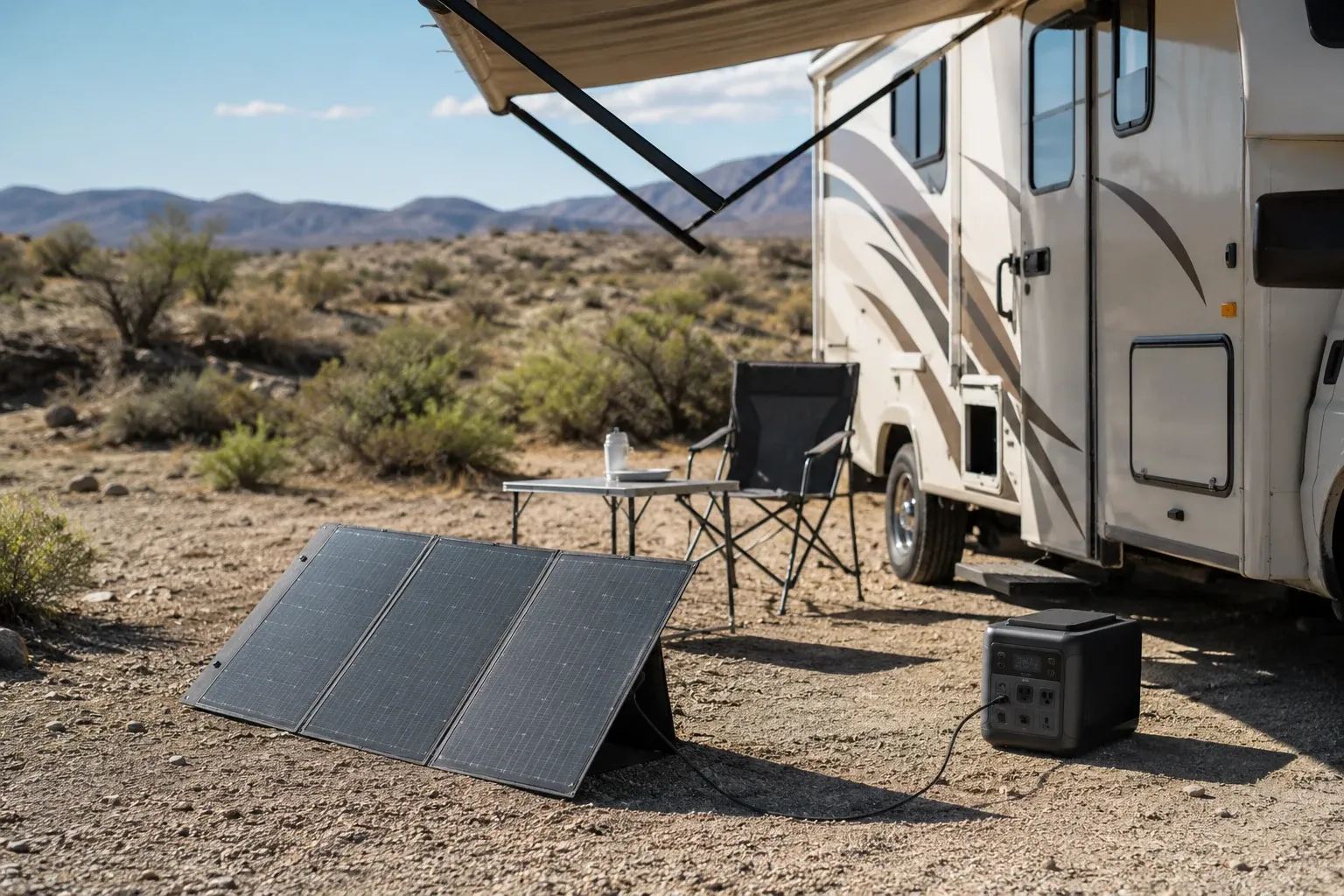
The solar input rating on the unit is a ceiling — exceed it and you are spending money on panel wattage the unit can't use. Voltage matters as much as wattage: the panel's open-circuit voltage (Voc) must fall inside the unit's MPPT range, which is typically 12–60V on mid-range units and wider on the larger ones. Two 200W panels in series usually fit; two 400W panels in series often do not.
The 12V output matters more than people think
A regulated 12V output rated at 10A or more lets you power 12V RV accessories — fridges, fans, water pumps, lights — directly from the power station without going through the inverter. Skipping the inverter conversion saves 10–15% of every watt-hour. On the units here, the Bluetti AC180 and AC200L have the cleanest 12V regulation.
Pure sine wave is non-negotiable
Cheaper modified sine wave inverters damage modern electronics. Anything you would consider for RV use should have a pure sine wave inverter. Every unit in this roundup does — but if you find yourself looking at a cheaper unit not listed here, confirm this on the spec sheet before buying.
Cold-weather behavior
LiFePO4 chemistry stops accepting a charge below 32°F (0°C) and degrades faster above 113°F (45°C). Several Bluetti and EcoFlow units include integrated low-temperature heaters that draw a small amount of capacity to keep the cells charge-ready in winter. If you camp cold, that feature is worth specifically looking for. Either way, keep the unit inside the rig overnight — not in an external storage bay or under the trailer.
Sizing for your use case
The right unit depends less on the brand and more on how you actually camp. Six common scenarios and the unit that fits each:
| Scenario | Recommended pick | Why |
|---|---|---|
| Weekend warrior (1–3 nights) | Jackery Explorer 1000 v2 | Portable, covers a CPAP, lights, fridge, and devices, recharges from a 200W panel between trips. No need for more. |
| Multi-day boondocker (4–10 nights) | Bluetti AC180 + 200W solar | Capacity that absorbs a cloudy day without panic, 500W solar input that catches up the next morning. The class sweet spot. |
| Multi-week off-grid | Jackery Explorer 2000 v2 + 400W solar | The capacity buffer covers two-day storms; the 1,400W solar input refills faster than the unit drains during normal use. |
| Full-time van life / small RV | Bluetti AC200L (expandable) + 600W solar | Start at 2,048Wh and add a battery when reality intervenes. Powers a residential fridge, induction cooktop in moderation, and a roof fan continuously. |
| Full-time fifth-wheel / large RV with AC | EcoFlow Delta Pro + 1,200W solar (with soft-start) | The 3,600W inverter starts an RV rooftop air conditioner with a soft-start kit and runs it for 1.5–2 hours per 2,000Wh consumed. |
| Renting an RV (no install option) | Jackery Explorer 1000 v2 or Bluetti AC180 | Both are light enough to pack in a checked bag (under the 100Wh limit applies only to airlines — these go in your vehicle), and they don't require rewiring anything in a rental. |
Built-in RV electrics vs portable solar generator
If your RV already has a 200–400Ah lithium house battery and 400W of roof-mounted solar, you may not need a portable power station at all. The portable solar generator is the right call when you are renting an RV and can't modify its electrical system, when you want to add capacity without re-wiring, or when you want a unit that doubles as home backup when you are not on the road. For permanent installs with serious capacity, a dedicated lithium house battery system is more cost-effective per watt-hour and integrates with the converter and inverter the rig was built around.
Frequently asked questions
What size solar generator do I need for my RV?
For a weekend trip running lights, devices, and a 12V fridge, 1,000Wh of usable capacity is enough. For multi-day boondocking add a CPAP machine and you want 1,500–2,000Wh. Full-time off-grid with a residential fridge, fans, and occasional kettle starts at 3,000Wh and pairs with 400W or more of solar.
Will a portable power station run an RV air conditioner?
A typical 13,500 BTU RV rooftop air conditioner needs 1,500–2,500W to start and 1,200–1,800W to run continuously. The 2,400W-and-above inverters in this list (AC200L, Jackery 2000 v2, Delta 2 Max, Delta Pro) can run one. Expect roughly 1.5–2 hours of runtime per 2,000Wh consumed. Pairing the unit with a soft-start kit on the AC dramatically reduces the surge requirement.
Can a solar generator replace an RV house battery?
For occasional weekend RVers, yes — a 2,000Wh portable unit covers most weekend needs without modifying the rig's electrical system. For full-time off-grid living, a built-in 200–400Ah lithium house battery is more cost-effective per watt-hour and integrates better with the converter and inverter system. The portable solar generator is most useful as a flexible backup or a renter's solution.
How many solar panels do I need for an RV solar generator?
Match your panel wattage to the unit's solar input ceiling. Two 200W portable panels (400W total) keep a 2,000Wh unit topped up during a typical day of off-grid use. For larger units in the 3,000Wh+ class with 1,200–1,600W solar input, run three to four 400W panels. Voltage matters too — the panel's open-circuit voltage must fall inside the power station's MPPT range, typically 12–60V.
Are LiFePO4 batteries worth it for RV use?
Yes, in 2026 there is no reason to buy an RV power station with older NMC lithium cells. LiFePO4 (lithium iron phosphate) batteries cycle 3,000–6,000 times to 80% capacity versus 500–1,000 for NMC, tolerate heat better, and have no thermal runaway risk. Every unit in this roundup uses LiFePO4.
Can I use a portable power station in cold weather?
Yes, but with caveats. LiFePO4 chemistry stops accepting a charge below 32°F (0°C). Discharging works down to about 0°F (–18°C) but available capacity drops 10–20% in the cold. Several units in this list (notably some Bluetti and EcoFlow models) include integrated heaters that draw a small amount of capacity to keep the cells charge-ready in winter. Keep the unit inside the rig overnight rather than in an external storage bay if you camp cold.
Final verdict
The portable power category has matured to the point where there is no obviously wrong choice in the $700–2,000 bracket — every unit in this roundup uses LiFePO4 cells, carries a five-year warranty, and has been refined over multiple product generations. The differences that remain are about fit: weight, inverter headroom, solar input ceiling, and how the 12V output behaves with RV accessories.
For most RVers reading this in 2026, the Bluetti AC180 is the unit that wastes the least of your time. For everyone else, the picks above map to specific use cases. Match the unit to the trip, not the marketing.