
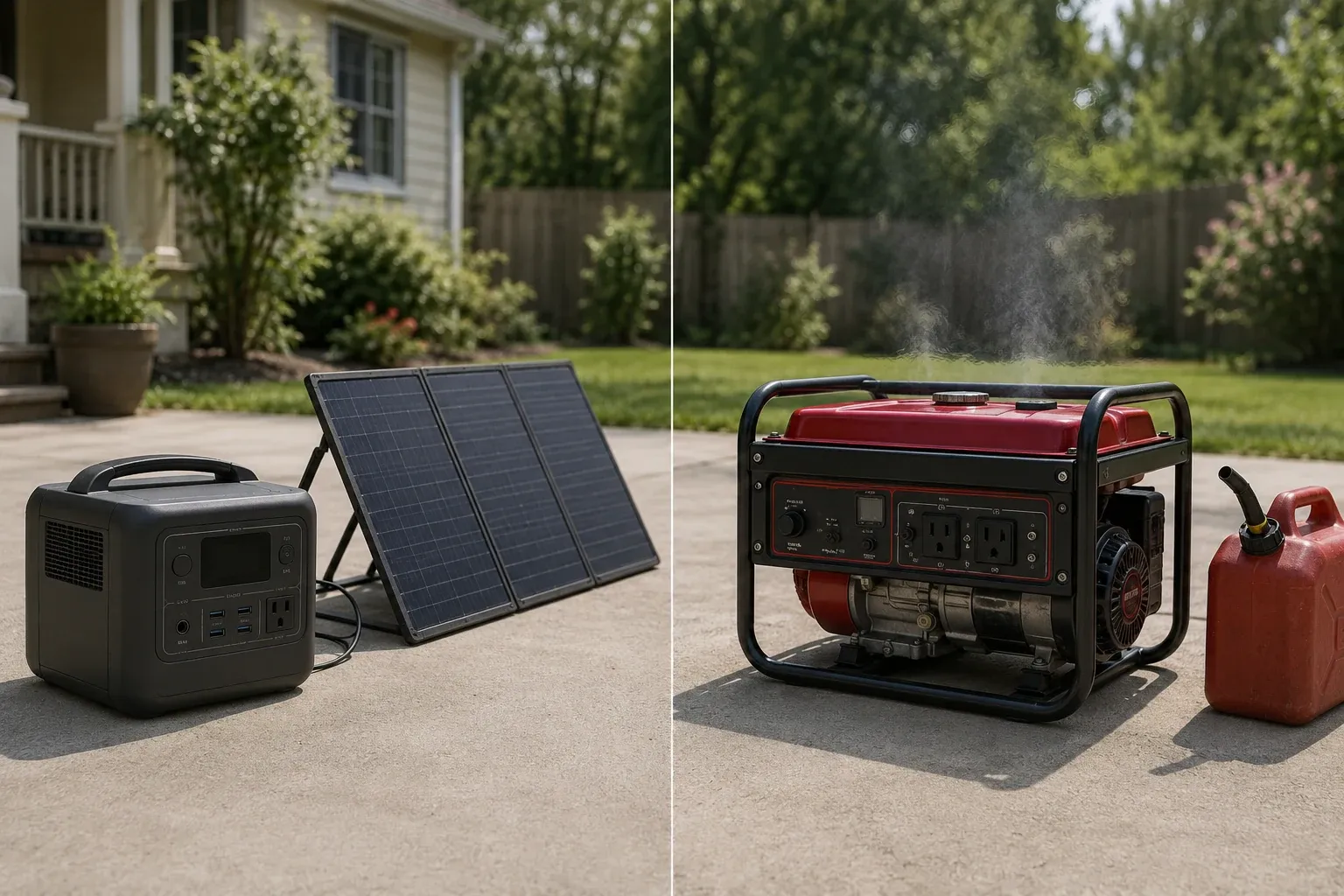
A solar generator and a gas generator solve the same problem — power away from the grid — in opposite ways, and neither wins outright. A solar generator (a battery with an inverter, recharged by solar panels) is quiet, fuel-free, and safe indoors, but its output is capped by the size of its battery. A gas generator runs as long as you keep feeding it fuel and delivers far more sustained wattage, but it is loud, needs ventilation, and cannot go inside. The right choice comes down to two questions: how much power you need at once, and for how long. This comparison works through both with real numbers.
What each one actually is
A solar generator is marketing shorthand for a portable power station paired with solar panels. Inside the unit is a lithium battery, an inverter that turns its DC into household AC, and a charge controller. It stores energy — it does not produce it. The panels refill the battery; the battery does the work. There is no engine, no fuel, no exhaust.
A gas generator burns gasoline (or propane) in a small engine that spins an alternator, producing electricity on demand. It generates energy continuously while running. Modern “inverter” gas generators add electronics that clean up the power output and throttle the engine to match the load, making them quieter and more fuel-efficient than the older open-frame type — but they are still combustion engines.
That structural difference — stored energy versus generated energy — drives every trade-off below.
Power output, head to head
For starting and running appliances, the relevant figures are continuous wattage and surge wattage. Here is how typical mid-range units compare:
| Solar generator (2,000Wh class) | Gas inverter generator (mid-size) | |
|---|---|---|
| Continuous output | 2,000–2,400W | 2,200–3,500W |
| Surge output | 3,000–4,000W | 2,800–4,500W |
| Sustained high load | Limited by battery | Unlimited (with fuel) |
| Output stability | Perfectly clean (pure sine) | Clean on inverter models |
| Scales up by | Adding batteries | Buying a bigger engine |
On instantaneous output the two are close — both start a refrigerator, run power tools, and handle a microwave. The difference is duration. A 2,000Wh solar generator delivers 2,000W for about 50 minutes before the battery empties; a gas generator delivers its rated output for as long as there is fuel in the tank. For brief, high-wattage tasks they are equivalent. For sustained high draw, gas has no battery to drain.
Runtime and refueling — the honest reality
This is where the categories separate, and where most marketing oversells solar.
A gas generator’s runtime is a function of tank size and load: a typical mid-size unit runs 8–12 hours on a tank at half load, and you extend it indefinitely by refueling. Keep jerry cans on hand and it runs for days.
A solar generator’s runtime is its usable battery capacity divided by your load. A 2,000Wh unit running a 200W load lasts about 8.5 hours, then stops until the sun refills it. Panels change the equation but do not remove the ceiling: 400W of solar returns roughly 2,000–2,500Wh on a good day, enough to refill the unit and run moderate loads indefinitely — but a cloudy stretch or a load larger than the panels can replace will outrun it.
The honest framing: a gas generator gives you uninterrupted high output limited only by fuel. A solar generator gives you silent, fuel-free power limited by battery and sunlight. Neither limitation is a flaw; they are different tools.
Total cost over ten years
Upfront price favors gas. Lifetime cost is closer than it looks, and for intermittent use solar often wins. A realistic ten-year comparison for a household using backup power roughly 50 hours a year:
| Cost over 10 years | Solar generator (2,000Wh + 400W solar) | Gas inverter generator (3,000W) |
|---|---|---|
| Purchase | ~$1,800 | ~$900 |
| Fuel (50 hrs/yr) | $0 | ~$875 |
| Oil + maintenance | ~$0 | ~$300 |
| Battery / engine replacement | Battery still >80% (LiFePO4) | Possible carb/engine service |
| 10-year total | ~$1,800 | ~$2,075 |
The solar unit costs roughly twice as much on day one and ends up slightly cheaper by year ten, because it burns nothing and a LiFePO4 battery still holds over 80% of its capacity after that period. The math flips if you run the generator heavily: a contractor running a gas generator 40 hours a week will never approach that with a solar unit, and the fuel cost, while real, buys output a battery simply cannot sustain. Use pattern decides the winner, not the sticker price.
Noise
Noise is the difference people underestimate until they live with it. A solar generator runs near-silent — only a cooling fan, at roughly 30–50 dB under load, quieter than normal conversation. A conventional open-frame gas generator runs 60–75 dB, in the range of a vacuum cleaner to a busy street, loud enough to carry across a campground. A modern gas inverter generator is much better at about 52–58 dB, but it is still clearly audible from the next campsite.
This is not a minor point. National parks and many campgrounds enforce generator quiet hours; neighborhoods during an outage notice the one house running a gas generator at 2 a.m. For any setting where noise matters — sleeping, working, anywhere with people nearby — the solar generator is the only option that disappears into the background.
Where each one is safe and legal
A solar generator produces no exhaust, so it runs safely indoors — in a house during an outage, inside a tent, in an RV. A gas generator produces carbon monoxide and must never run indoors or in any enclosed or partially enclosed space; even outdoors it needs to sit well clear of windows, doors, and vents. Carbon-monoxide poisoning from improperly placed generators causes deaths during every major outage, and it is entirely avoidable.
Beyond safety, location rules matter: campground quiet hours, HOA restrictions, and apartment balconies all effectively rule out gas generators in places a solar unit is welcome.
Maintenance and lifespan
A solar generator has no moving parts beyond a cooling fan. There is nothing to service — no oil, no spark plugs, no fuel stabilizer, no carburetor to gum up if it sits unused. It can be stored at partial charge for months and works the moment you need it. A LiFePO4 unit holds usable capacity for 3,000+ charge cycles, effectively a decade or more of normal use.
A gas generator is a small engine and needs the upkeep of one: oil changes, fuel stabilizer or draining for storage, periodic carburetor cleaning, and the occasional pull-start frustration after months idle. Run and maintained, it lasts many years; neglected, it fails exactly when an outage arrives.
Fuel and storage — the consideration people forget
A gas generator is only as ready as its fuel supply, and fuel is its own logistics problem. Gasoline degrades: untreated, it begins to go stale in about 30 days and gums up a carburetor within a few months. Running a gas generator as reliable backup means storing fuel, rotating it, and adding stabilizer — or draining the system before long storage. Stored gasoline is also a fire and code consideration; many jurisdictions limit how much you can keep, and an attached garage is a poor place for it. Propane sidesteps the staleness problem (it stores for years) but trades it for bulky tanks and lower cold-weather output.
A solar generator has no fuel to buy, store, rotate, or spill. It sits on a shelf at partial charge and is ready whenever you need it, and its “fuel” — sunlight — arrives free and cannot be stockpiled wrong. For anyone who wants backup power that demands nothing between emergencies, this is a quiet but decisive advantage. The flip side is the one already covered: when the battery and the sun run out, there is no jerry can to top it up. Fuel logistics are the price of the gas generator’s open-ended runtime, and freedom from them is part of what you buy with solar.
Which to buy — the decision
Match the tool to the scenario:
- Buy a solar generator if your use is intermittent — outage backup for essentials, camping, RV trips — and you value silence, indoor safety, and zero maintenance. It covers a fridge, lights, internet, devices, and a CPAP through an outage without a sound, and pairs with solar panels to extend indefinitely.
- Buy a gas generator if you need sustained high output for long stretches — running central air conditioning for days, a well pump, a jobsite, or backing up a whole house through a multi-day outage. Fuel is the cost of capability a battery can’t match.
- Run both if you can. Many prepared households keep a solar generator for quiet overnight essentials and a gas generator for daytime heavy loads. The solar unit handles the fridge and the bedroom CPAP silently at night; the gas unit runs the AC and recharges the solar battery during the day.
For where a solar generator fits home backup specifically, see the home backup guide; for the off-grid and travel side, the RV solar generators roundup. The solar generators overview covers the category from the top, and every figure here follows our testing methodology.
Recommended solar generators
If the comparison points you toward solar, these units cover the common cases:
- The Bluetti AC200L — 2,048Wh, expandable to 8,192Wh, with a 2,400W inverter and 1,200W solar input. The closest a portable unit gets to replacing a gas generator for home essentials.
- The EcoFlow Delta 2 — 1,024Wh, fast-charging and expandable, a flexible entry point for outage backup.
- The Anker SOLIX C1000 — strong value with the highest solar input in its class for a solar-first setup.
The short version
A gas generator generates power and runs as long as you fuel it — the tool for sustained, high-wattage, multi-day demands, at the cost of noise, fumes, fuel, and maintenance. A solar generator stores power and runs silently and safely indoors — the tool for quiet, intermittent backup and off-grid trips, capped by battery size and sun. For most households backing up essentials, the solar generator is the better fit and slightly cheaper over a decade. For whole-house or jobsite duty, gas still wins. Buy for the job you actually have.