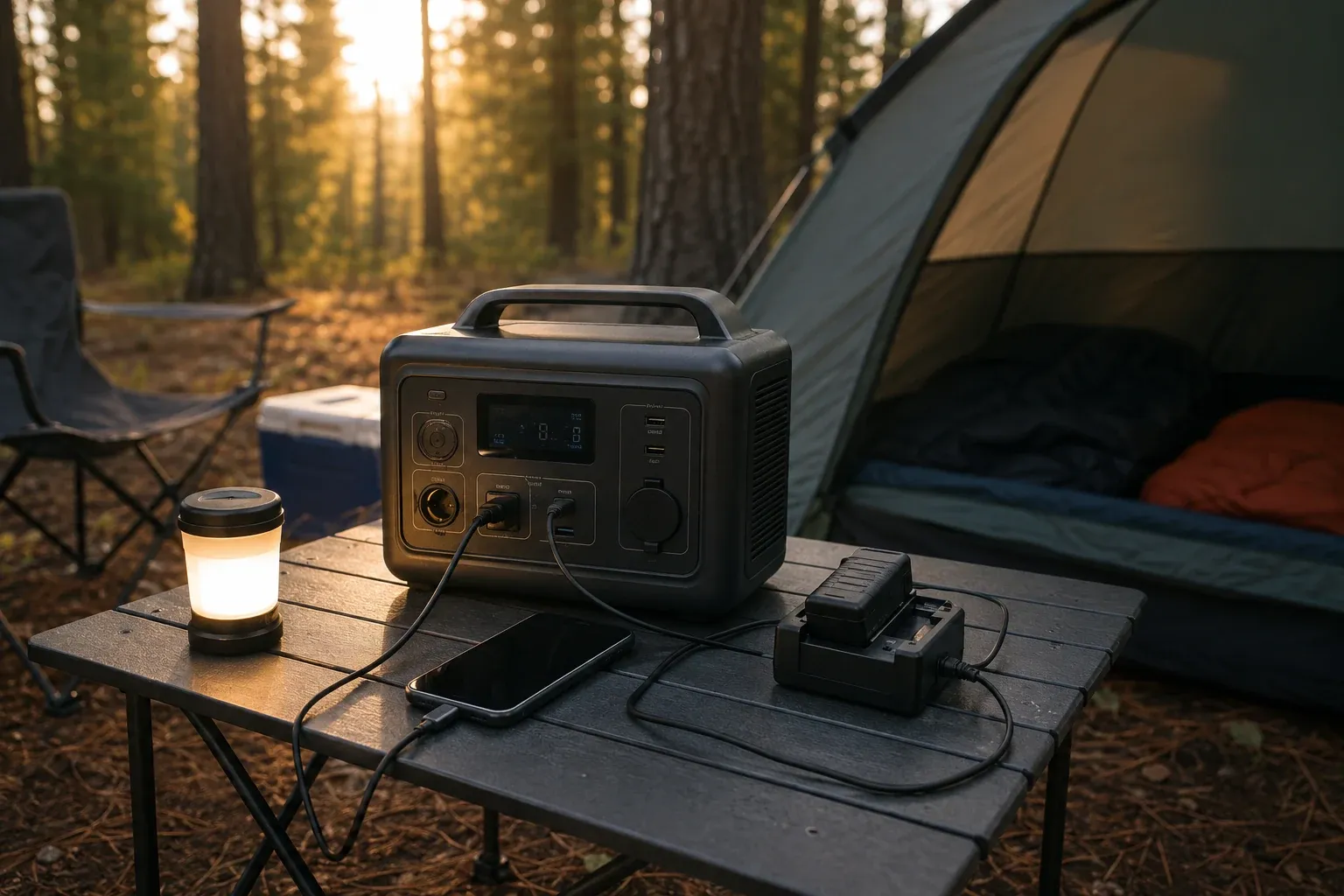
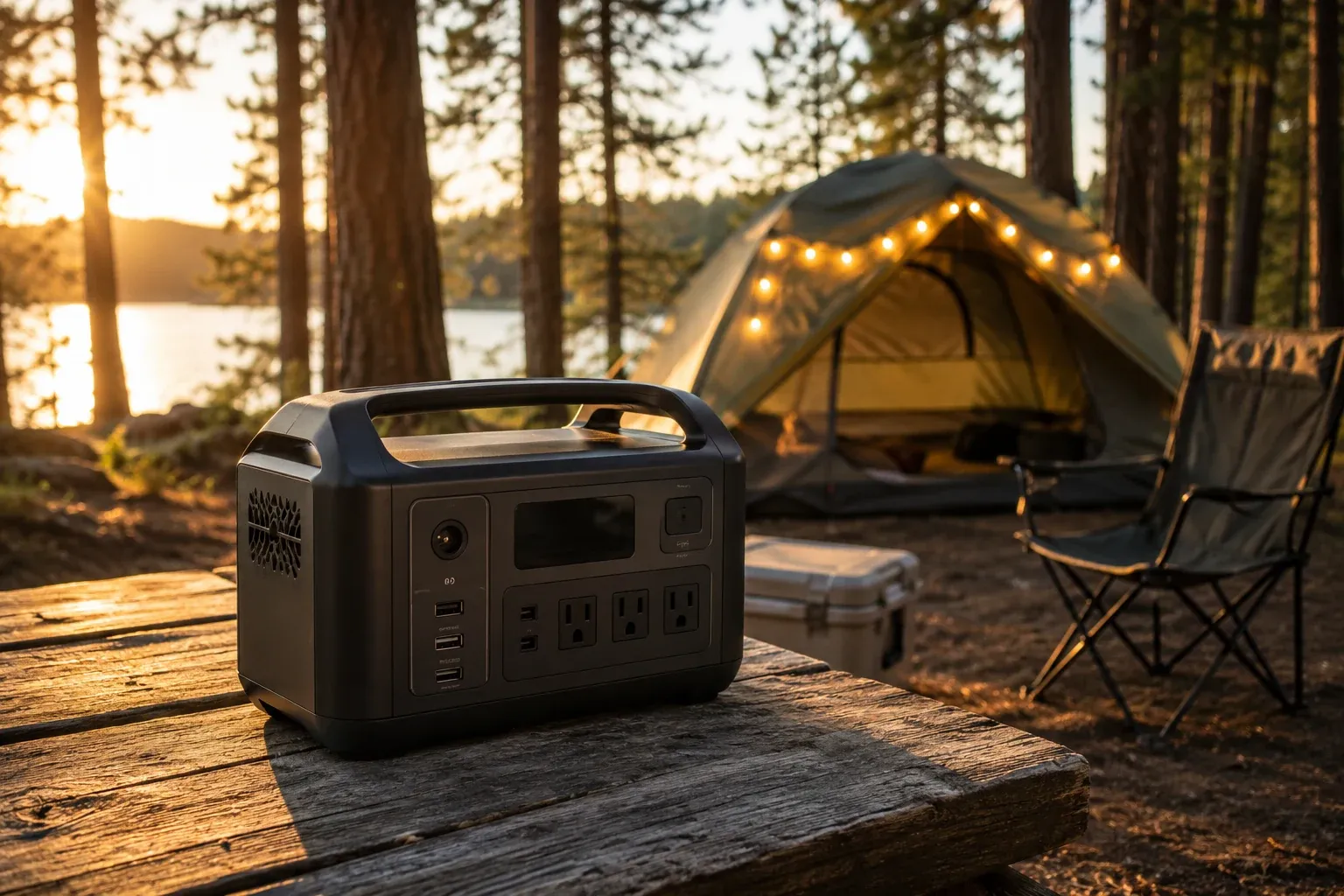
The short answer
Camping is the one use case where bigger isn't better — you carry the thing, so weight and noise matter as much as watt-hours. For most campers the Jackery Explorer 1000 v2 is the best overall pick: the lightest 1,000Wh-class unit at 23.8 pounds, enough to run a fridge, CPAP, and lights for a long weekend, and quiet in a tent. For a lighter, cheaper weekend unit, the Bluetti AC70 (768Wh, 22.5 lbs) is the value sweet spot.
Packing light? The EcoFlow River 3 Plus (under 10 lbs, expandable) and the ultralight Jackery Explorer 300 (7.1 lbs) cover device-and-lights trips. Camping out of the car, where weight stops mattering? The Bluetti AC180 gives you the most usable capacity. Not sure what size you need? Start with our camping sizing guide.
Top picks at a glance
- Best Overall for Camping: Jackery Explorer 1000 v2
- Best Mid-Size (Sweet Spot): Bluetti AC70
- Best Value: Anker SOLIX C1000
- Best Compact: EcoFlow River 3 Plus
- Best Ultralight: Jackery Explorer 300
- Best Budget: Anker SOLIX C300
- Best for Car Camping: Bluetti AC180
- Best for Family / Group: EcoFlow Delta 2
Comparison table
| Unit | Capacity | Weight | Inverter | Solar in |
|---|---|---|---|---|
| Jackery Explorer 1000 v2 | 1,070 Wh | 23.8 lbs | 1,500 W continuous | 400 W max |
| Bluetti AC70 | 768 Wh | 22.5 lbs | 1,000 W continuous | 500 W max |
| Anker SOLIX C1000 | 1,056 Wh | 28.4 lbs | 1,800 W continuous | 600 W max |
| EcoFlow River 3 Plus | 286 Wh | 9.7 lbs | 300 W continuous | 220 W max |
| Jackery Explorer 300 | 293 Wh | 7.1 lbs | 300 W continuous | 90 W max |
| Anker SOLIX C300 | 288 Wh | 8.2 lbs | 300 W continuous | 100 W max |
| Bluetti AC180 | 1,152 Wh | 37 lbs | 1,800 W continuous | 500 W max |
| EcoFlow Delta 2 | 1,024 Wh | 27 lbs | 1,800 W continuous | 500 W max |
Best Overall for Camping
Jackery Explorer 1000 v2
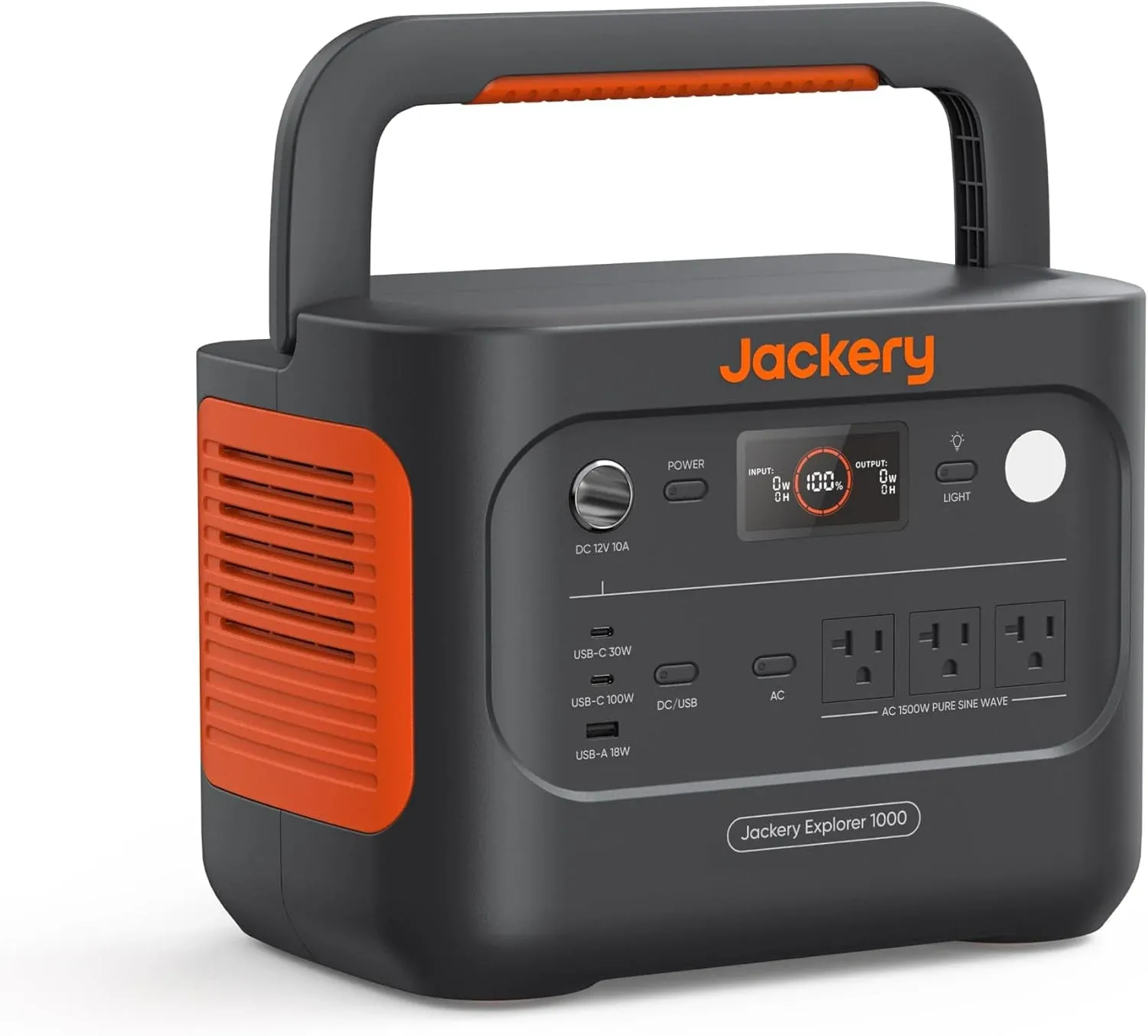
If you want one power station that covers nearly any camping trip and is still light enough to carry from the car without resenting it, this is the one. At 23.8 pounds the Explorer 1000 v2 is the lightest LiFePO4 unit in its capacity class, and 1,070Wh is plenty for a long weekend with a fridge, lights, and a CPAP.
- Capacity
- 1,070 Wh (LiFePO4)
- Weight
- 23.8 lbs
- Inverter
- 1,500 W continuous · 3,000 W surge
- Solar input
- 400 W max
- Warranty
- 5 years
Why it works for camping
Weight is the spec that matters most when you're the one hauling gear to the site, and the Explorer 1000 v2 wins it for its capacity. The fan is quiet enough not to bother a tent, the 3,000W surge starts a 12V cooler's compressor without complaint, and a single 200W panel tops it up in a day. For most campers this is the sweet spot between "enough power" and "still portable."
Pros
- Lightest 1,000Wh-class unit at 23.8 lbs — easy to carry to the site
- Quiet fan, close to silent under light camp loads
- 3,000W surge starts a 12V cooler cleanly
- LiFePO4 cells, 5-year warranty
- Clean app for checking charge at a glance
Cons
- 400W solar input is modest if you camp off-grid for a week-plus
- No expansion option
- Costs more than the Anker C1000 for similar capacity
The bottom line: The default camping pick. Enough power for almost any trip, light enough that you'll actually bring it.
Check price on Amazon →Best Mid-Size (Sweet Spot)
Bluetti AC70
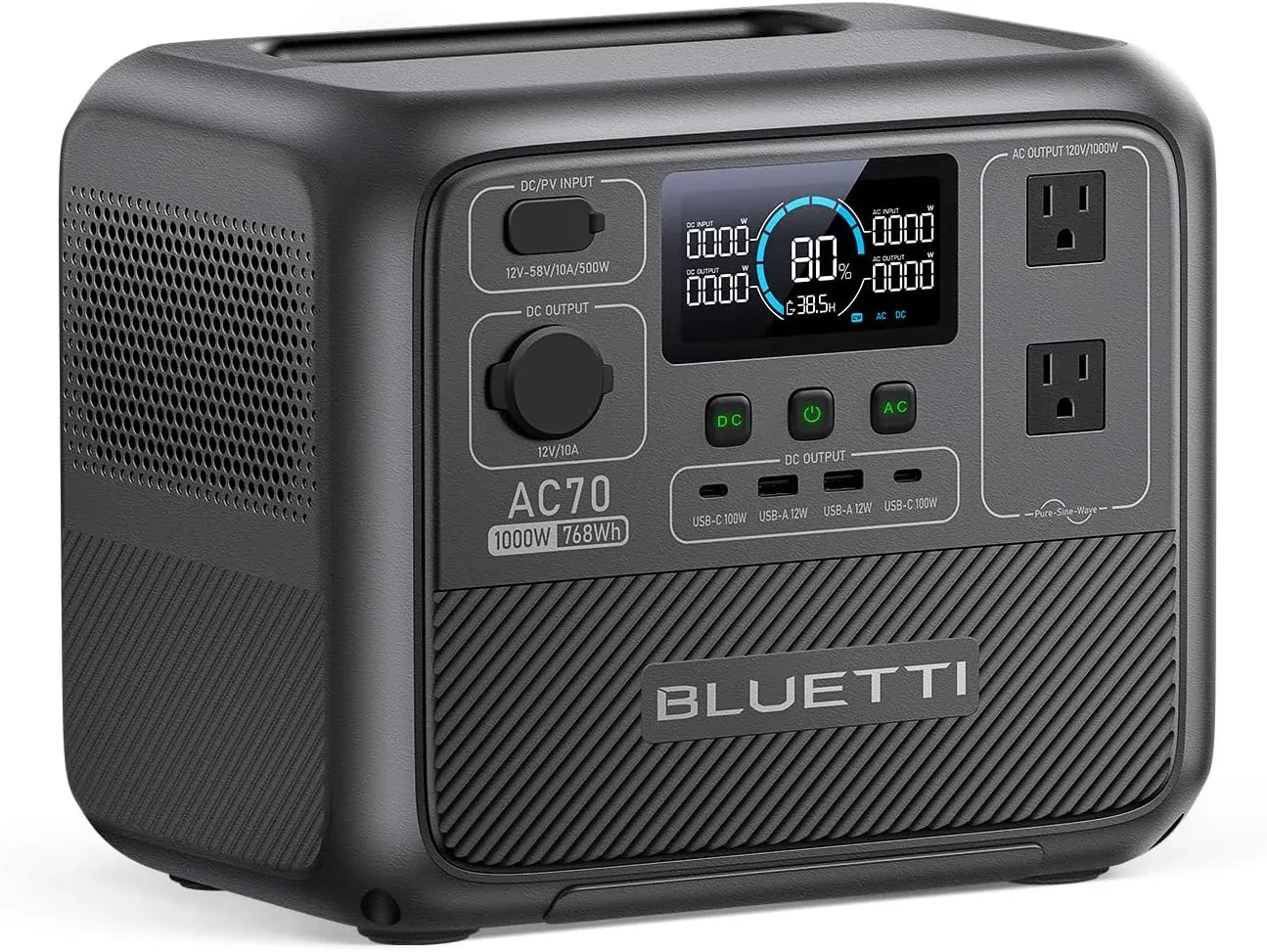
The AC70 sits in the spot a lot of campers actually want: enough capacity for a weekend, light enough to carry one-handed, and priced well below the 1,000Wh units. 768Wh covers a fridge overnight, devices, and lights with room to spare, and Power Lifting mode pushes resistive loads to 2,000W.
- Capacity
- 768 Wh (LiFePO4)
- Weight
- 22.5 lbs
- Inverter
- 1,000 W continuous · 2,000 W Power Lifting
- Solar input
- 500 W max
- Warranty
- 5 years
Why it works for camping
For the camper who doesn't need a full 1,000Wh but wants more than a tiny unit, the AC70 is the value sweet spot. At 22.5 pounds it's genuinely portable, the 500W solar input is high for the size (it refills fast on a single panel), and the build is the same quiet, well-made Bluetti you get a tier up. It punches above its capacity for weekend trips.
Pros
- Excellent capacity-to-weight at 22.5 lbs for 768Wh
- High 500W solar input for the size — fast refill
- Power Lifting runs resistive loads to 2,000W
- Quiet, well-built, 5-year warranty
- Priced below the 1,000Wh class
Cons
- 768Wh is tight for multi-day trips with a fridge
- No app on this model
- 1,000W continuous limits high-draw appliances
The bottom line: The smart-money mid-size pick. The best balance of capacity, weight, and price for weekend camping.
Check price on Amazon →Best Value
Anker SOLIX C1000
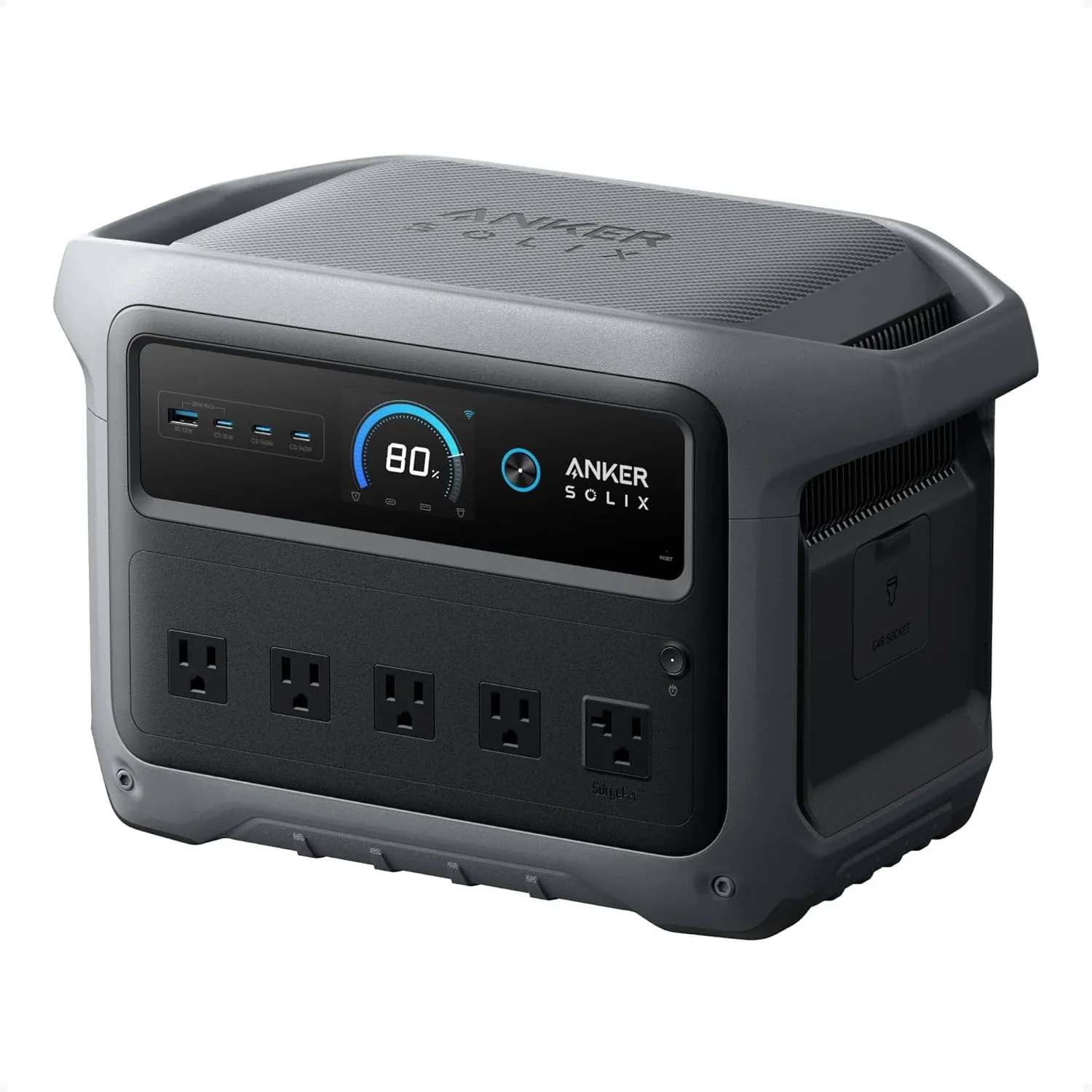
If you want 1,000Wh of camping power for the least money, the SOLIX C1000 is reliably the cheapest of the mainstream units — and it hands you the highest solar input in the class while it's at it. For car campers who don't mind 28 pounds, it's hard to beat on value.
- Capacity
- 1,056 Wh (LiFePO4)
- Weight
- 28.4 lbs
- Inverter
- 1,800 W continuous · 2,400 W surge
- Solar input
- 600 W max
- Warranty
- 5 years
Why it works for camping
The 600W solar input is the standout: more than any other 1,000Wh unit, which means faster recharge and room to add a second or third panel for longer trips. The 1,800W inverter handles a camp kettle or small appliance, and UltraFast charging means you arrive at the site full after a quick top-up. The only camping give-up is weight — 28 pounds is car-camping territory.
Pros
- 600W solar input — highest in the 1,000Wh class
- Lowest price of the mainstream 1,000Wh units
- UltraFast charging tops it up before you leave
- 1,800W inverter handles camp appliances
- LiFePO4, 5-year warranty
Cons
- 28.4 lbs — fine for car camping, heavy to carry far
- 2,400W surge trails the Jackery on the biggest loads
- App less polished than Jackery or EcoFlow
The bottom line: The value champion. Most solar input and capacity per dollar — best for car campers watching the budget.
Check price on Amazon →Best Compact
EcoFlow River 3 Plus
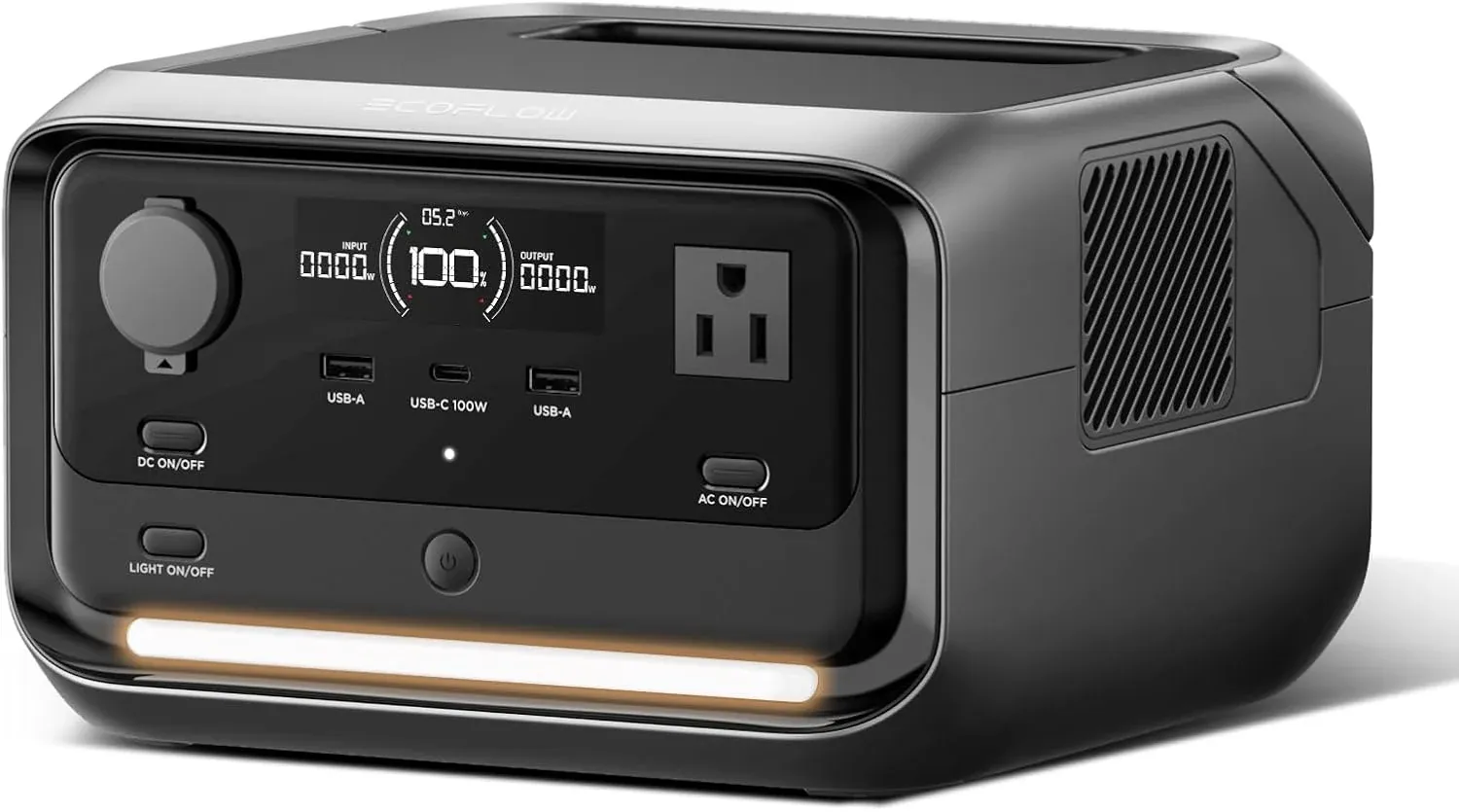
When you want real power but not a 25-pound box, the River 3 Plus is the compact answer. 286Wh in a 9.7-pound package runs your devices, lights, and a CPAP through a night, and the expansion battery doubles it to 858Wh if a trip runs long — so you can travel light and scale up only when you need to.
- Capacity
- 286 Wh (LiFePO4, expandable to 858 Wh)
- Weight
- 9.7 lbs
- Inverter
- 300 W continuous · 600 W X-Boost
- Solar input
- 220 W max
- Warranty
- 5 years
Why it works for camping
This is the unit for the camper who carries gear rather than parks next to it. Under 10 pounds, it fits in a pack-out tote and disappears in the trunk, yet X-Boost runs a 600W appliance in a pinch and the 220W solar input refills it fast on a small panel. The expansion option means one compact unit covers both overnight trips and the occasional longer haul.
Pros
- Under 10 lbs — genuinely packable
- Expandable to 858Wh for longer trips
- Fast recharge and 220W solar input for the size
- X-Boost runs up to 600W resistive loads
- LiFePO4, 5-year warranty
Cons
- 286Wh base capacity is a single-night reserve
- 300W continuous rules out high-draw appliances
- Expansion battery adds cost and weight
The bottom line: The best compact pick. Light enough to carry anywhere, with the option to scale up when a trip demands it.
Check price on Amazon →Best Ultralight
Jackery Explorer 300
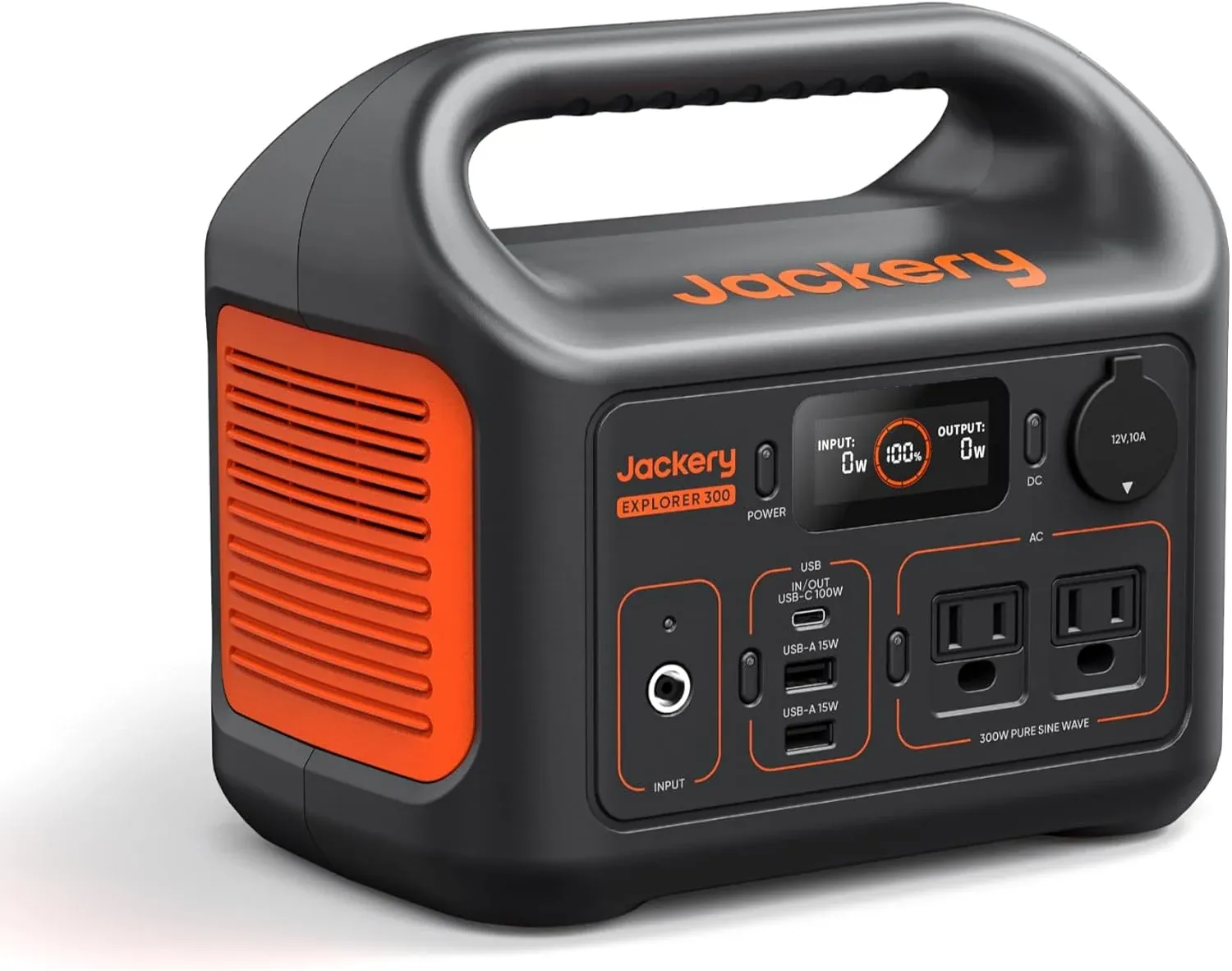
At 7.1 pounds the Explorer 300 is the one you barely notice in the pack. It's a proven, popular ultralight unit for campers who only need to keep phones, a camera, lights, and a small device topped up — not run a fridge. For minimalist trips it's all the power you need and nothing you have to carry.
- Capacity
- 293 Wh
- Weight
- 7.1 lbs
- Inverter
- 300 W continuous · 500 W surge
- Solar input
- 90 W max
- Warranty
- 3 years (with registration)
Why it works for camping
Ultralight camping is about what you leave behind, and the Explorer 300 leaves behind the bulk. It charges phones a dozen times over, runs a string of camp lights for nights, and tops a laptop up through a weekend, all in a unit lighter than a full water bottle pack. The trade is honest: 293Wh and a 300W inverter mean it is a device-and-lights unit, not a fridge unit.
Pros
- Just 7.1 lbs — the lightest here by a wide margin
- Proven, popular ultralight design
- Quiet, simple, no setup
- Plenty for phones, camera, lights, a laptop
Cons
- 293Wh is a one-night reserve for small loads only
- Older NMC chemistry — shorter cycle life than LiFePO4
- 90W solar input and 300W inverter limit what it runs
- 3-year warranty vs 5 on the LiFePO4 units
The bottom line: The ultralight pick for minimalist trips. Carry it for devices and lights; step up if a fridge is on the packing list.
Check price on Amazon →Best Budget
Anker SOLIX C300
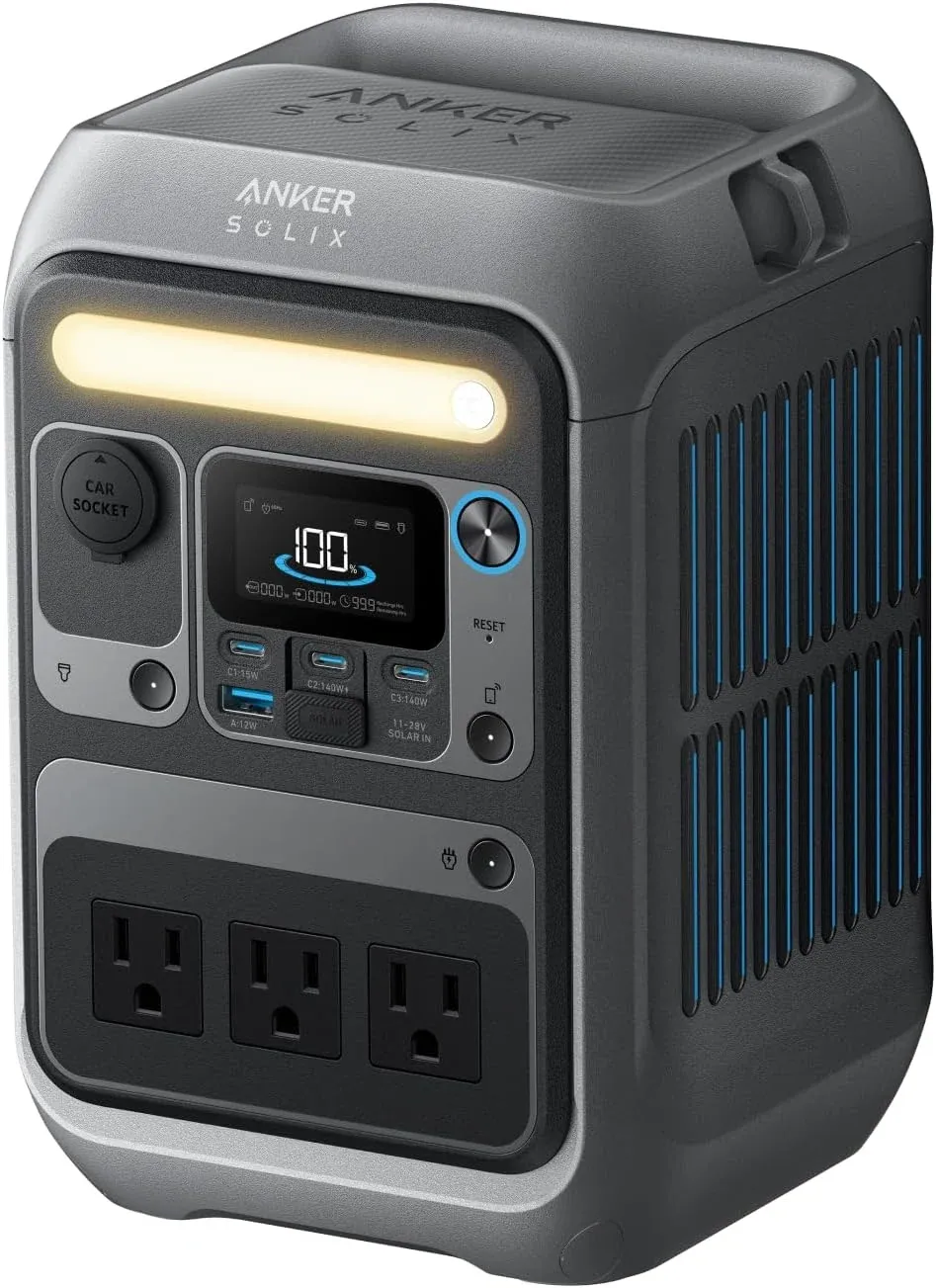
The SOLIX C300 is the budget unit that doesn't cut the corner that matters: it uses LiFePO4 cells, so unlike most cheap small stations it will last for years, not a couple of seasons. 288Wh at 8.2 pounds covers devices and lights for a weekend, at a price that makes it an easy first power station.
- Capacity
- 288 Wh (LiFePO4)
- Weight
- 8.2 lbs
- Inverter
- 300 W continuous · 600 W surge
- Solar input
- 100 W max
- Warranty
- 5 years
Why it works for camping
For a first camping power station or a lightweight backup, the C300 is the value entry. The LiFePO4 cells are the headline — 3,000+ cycles where budget rivals use short-lived NMC — and the 600W surge handles brief spikes the rated 300W wouldn't suggest. It is a devices-and-lights unit like the others in this size, but it is the one built to last.
Pros
- LiFePO4 at a budget price — rare in this size
- Light at 8.2 lbs, easy to pack
- 600W surge for brief spikes
- 5-year warranty
Cons
- 288Wh suits devices and lights, not a fridge
- 300W continuous limits appliances
- 100W solar input means slow off-grid refill
The bottom line: The budget pick that lasts. The cheapest way into a power station that won't die after two seasons.
Check price on Amazon →Best for Car Camping
Bluetti AC180
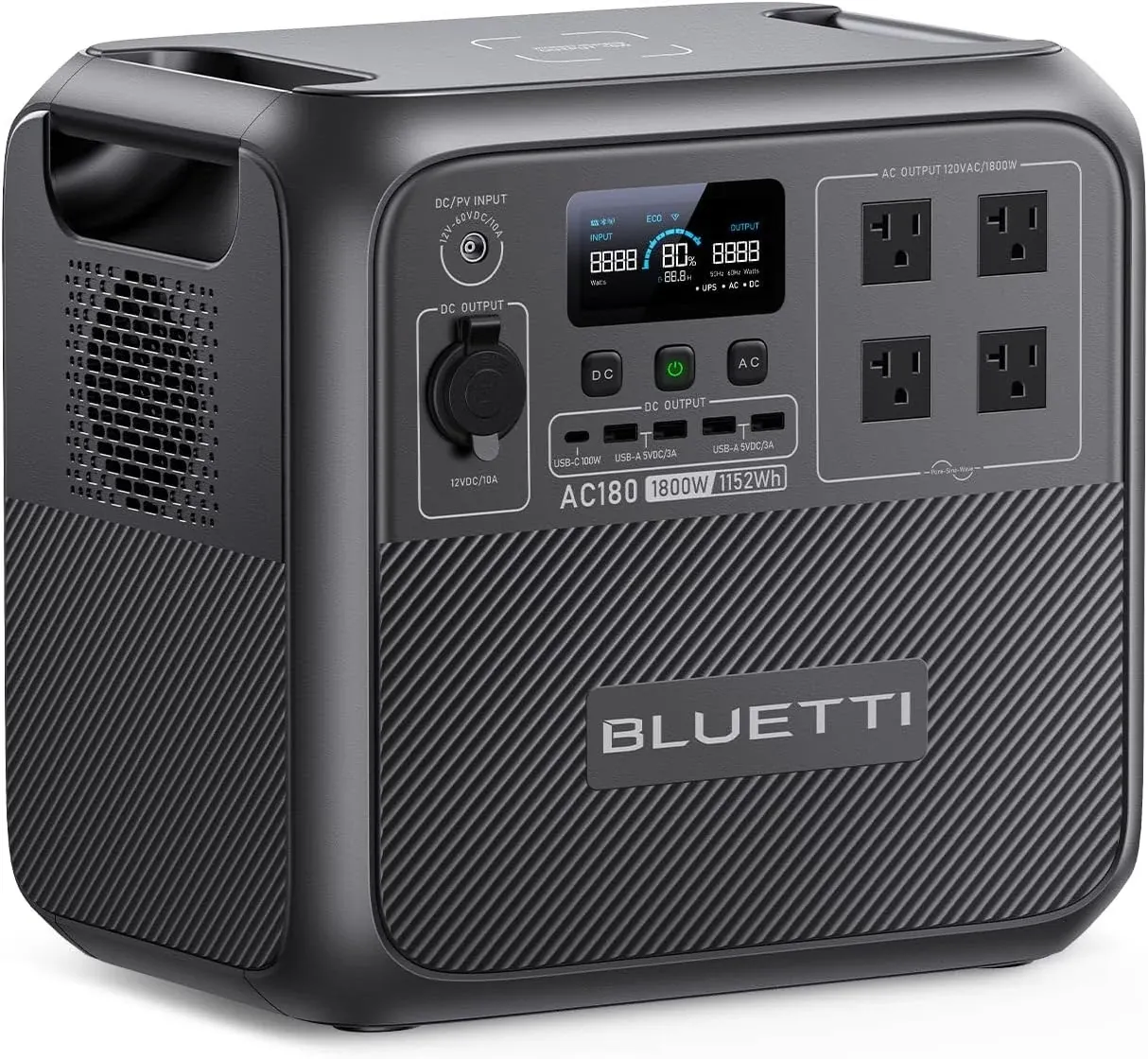
When the unit lives in the trunk and you camp out of the car, weight stops mattering and capacity takes over. The AC180's 1,152Wh and 1,800W inverter run a full cooler, lights, a fan, and a coffee maker across a long weekend, and the 2,700W surge starts a residential-style fridge without flinching.
- Capacity
- 1,152 Wh (LiFePO4)
- Weight
- 37 lbs
- Inverter
- 1,800 W continuous · 2,700 W surge
- Solar input
- 500 W max
- Warranty
- 5 years
Why it works for camping
Car camping changes the calculus — you're not carrying 37 pounds far, so the trade buys you the most usable capacity here for multi-day comfort. The 500W solar input refills it well, the inverter runs camp appliances a smaller unit can't, and it's the same quiet, dependable AC180 we recommend across use cases. For base-camp comfort over portability, it's the pick.
Pros
- 1,152Wh runs a full car-camp setup for days
- 1,800W / 2,700W inverter handles camp appliances
- 500W solar input for steady refill
- Quiet and well-built, 5-year warranty
Cons
- 37 lbs — car camping only, not a carry
- No app or expansion
- Overkill for minimalist trips
The bottom line: The car-camping pick. Maximum usable capacity for base-camp comfort when you don't have to carry it far.
Check price on Amazon →Best for Family / Group Camping
EcoFlow Delta 2
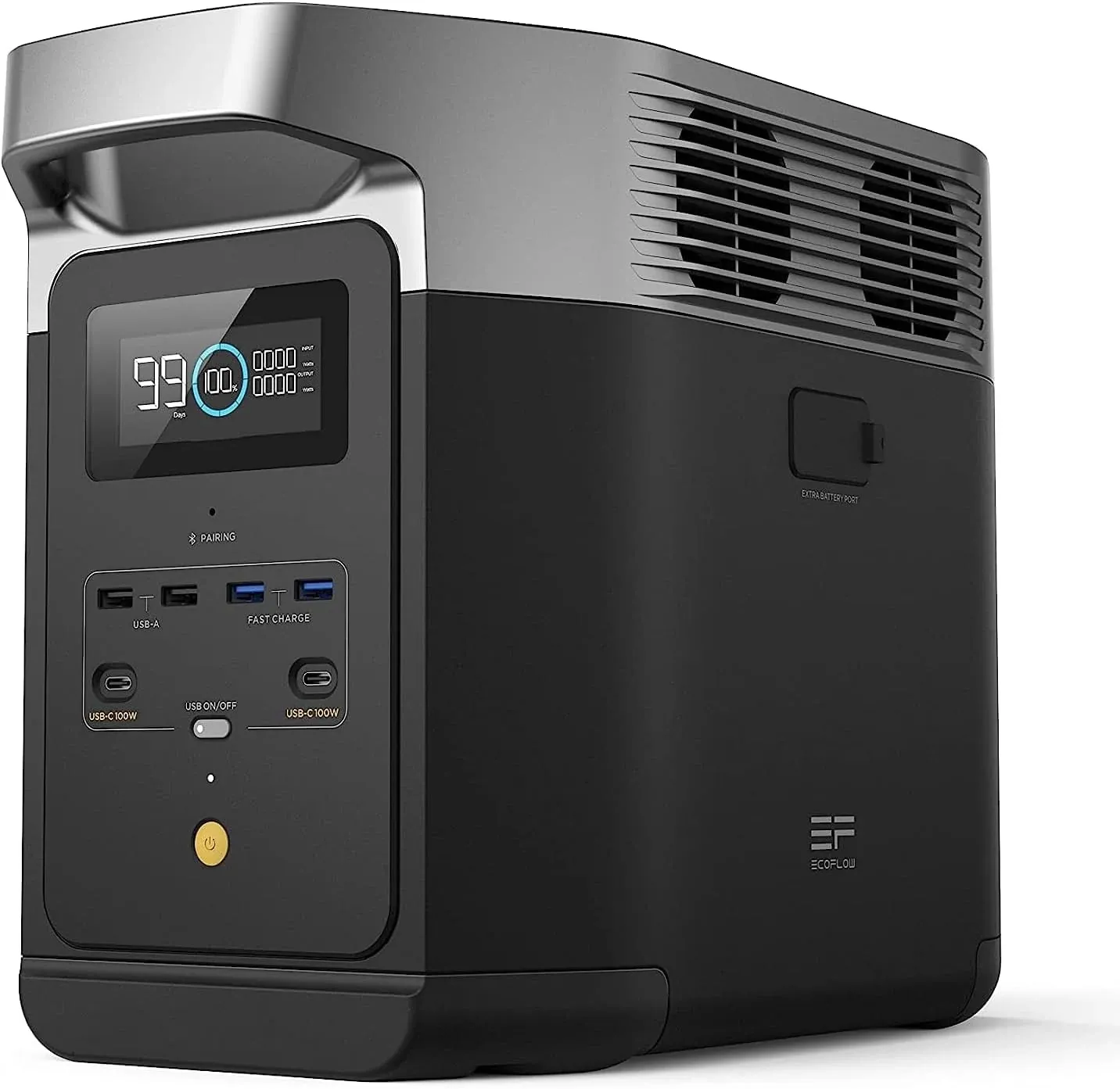
Group trips multiply the load — more phones, more lights, a bigger cooler, someone's CPAP, maybe a blender for the campsite margaritas. The Delta 2 handles it: 1,024Wh expandable to 3,040Wh, fast recharge for turning it around between days, and X-Boost to run resistive camp appliances up to 2,200W.
- Capacity
- 1,024 Wh (LiFePO4, expandable to 3,040 Wh)
- Weight
- 27 lbs
- Inverter
- 1,800 W continuous · 2,700 W surge (X-Boost 2,200 W)
- Solar input
- 500 W max
- Warranty
- 5 years
Why it works for camping
For families and groups, the expansion path is the reason to choose this: start at 1,024Wh and add a battery when the trip or the group grows, all charged by the same panels. Fast AC charging means a quick top-up at a trailhead outlet refills it before you head out, and the app lets everyone see what's left. It's the camping unit built to scale with the group.
Pros
- Expandable to 3,040Wh for groups and long trips
- Fast AC recharge between camp days
- X-Boost runs resistive loads to 2,200W
- Strong app with live readouts
- LiFePO4, 5-year warranty
Cons
- Fan audible under sustained high load
- 27 lbs base, more with the expansion battery
- Pricing swings — wait for a sale
The bottom line: The group-camping pick. Start at 1,024Wh and scale up as the trip and the headcount grow.
Check price on Amazon →How to choose a camping power station
Weight is the spec that decides the most
At home, a power station's weight is irrelevant — it sits in a closet. Camping flips that: every pound is a pound you carried from the car, and sometimes farther. That single fact reshapes the whole decision. Under 10 pounds (the River 3 Plus, Explorer 300, C300) goes anywhere. Around 22–28 pounds (AC70, Jackery 1000 v2, C1000) is a comfortable one-person carry for a short walk. Above 35 pounds (AC180) is car-camping gear — fine in the trunk, miserable to haul to a backcountry site. Buy the lightest unit that covers your trip, not the largest you can afford.
Size to your trip, and watch the cooler
Capacity is about how many nights you go between recharges, and the one load that dominates is a powered cooler. Phones, lights, and a camera barely clear 200Wh a day; add a CPAP and you near 500Wh; add a 12V fridge running around the clock and you pass 1,000Wh. If you bring a cooler, start at 1,000Wh and add solar. If you don't, a 300–768Wh unit is plenty. Our camping sizing guide walks through the math with a load table.
Noise matters more than the spec sheet admits
A cooling fan that's fine in a garage is intrusive in a quiet tent at night. The units here are chosen partly because they run quiet under typical camp loads — the smaller units are effectively silent, and the Jackery and Bluetti models keep the fan calm until you push them hard. If you'll run the unit overnight near where you sleep, this is worth as much as a watt-hour figure.
Solar for trips that run long
For one or two nights a fully charged station is enough — no panel needed. For three nights or more, a 100–200W folding panel keeps it topped up and removes the do-I-have-enough math from your evenings. Match the panel to the station's solar input and voltage window; our solar panel pairing guide covers how, and the field setup guide shows how to deploy panels at a site.
LiFePO4 unless you're counting every ounce
Every unit here uses LiFePO4 chemistry — 3,000+ cycles and years of life — except the ultralight Jackery Explorer 300, which trades older NMC cells for the lowest weight. For a station you'll use for seasons, LiFePO4 is worth the small premium; the exception is genuine ultralight trips where every ounce counts more than cycle life.
What these power stations actually run at camp
Watt-hours on a box don't mean much until you translate them into the things you actually plug in at a campsite. Two numbers make that translation honest. First, you never get the full rated capacity: after inverter and conversion losses, plan on roughly 85% of the label as usable energy for AC devices. Second, you need real draw figures for camp gear — so here are the ones we use: a phone full-charge is about 15Wh, an LED lantern or string lights pull around 6W, a CPAP with the humidifier off averages about 30W (≈240Wh across an 8-hour night), and a 12V compressor fridge averages roughly 40W in warm weather.
| Capacity tier | Phone charges | LED lantern | CPAP nights* | 12V fridge (warm) |
|---|---|---|---|---|
| ~290 Wh Explorer 300, SOLIX C300, River 3 Plus | ~16 charges | ~40 hrs | ~1 night | ~6 hrs continuous |
| ~768 Wh Bluetti AC70 | ~43 charges | ~108 hrs | ~2–3 nights | most of a day |
| ~1,050–1,150 Wh Jackery 1000 v2, C1000, AC180, Delta 2 | ~60 charges | ~150 hrs | ~3–4 nights | ~1.5–2 days |
*CPAP figures assume the humidifier and heated hose are off — the standard advice for battery use, since they can triple the draw.
Two things stand out. The cooler is almost always the load that decides your capacity: a fridge can quietly out-consume every other device on the table combined, which is why a cooler on the packing list pushes you to 1,000Wh. But the "continuous" fridge column understates real life — a compressor fridge cycles on and off rather than running flat-out, so a unit that shows "~6 hours continuous" will often carry a well-packed cooler through a cool night because the compressor is only working part of the time. Ambient temperature, how full the cooler is, and how often you open it swing fridge runtime more than any spec on the box.
Which size for your trip
The right pick depends less on the brand and more on how and how far you camp:
| Trip style | Recommended pick | Why |
|---|---|---|
| Ultralight / backpack-adjacent | Jackery Explorer 300 | 7.1 lbs for devices, lights, and a camera. The one you barely feel in the pack. |
| Minimalist on a budget | Anker SOLIX C300 | LiFePO4 longevity at the lowest price — devices and lights for a weekend, built to last. |
| Compact but flexible | EcoFlow River 3 Plus | Under 10 lbs, expandable to 858Wh — travel light, scale up when a trip runs long. |
| Weekend sweet spot | Bluetti AC70 | 768Wh at 22.5 lbs, high solar input, value price — the best all-round weekend pick. |
| Long weekend with a fridge | Jackery Explorer 1000 v2 | Lightest 1,000Wh unit — runs a 12V fridge, CPAP, and lights, and still carries easily. |
| Car camping / base camp | Bluetti AC180 | 1,152Wh and a strong inverter for multi-day comfort when you camp out of the car. |
| Family / group trips | EcoFlow Delta 2 | Expandable to 3,040Wh for the bigger cooler, the extra phones, and the group load. |
Camping power overlaps with off-grid travel — if you're powering a rig rather than a tent, the RV solar generators roundup is the better list. For the category from the top, see all our camping coverage, and every figure here follows our testing methodology.
How we test power stations for camping
Camping rewards different things than home backup does, so we judge these units against the camp use case specifically rather than copying spec sheets. Weight comes off a scale, not the brochure — manufacturer figures are usually honest but rounding and accessories add up, and the carry is the whole point here. We note fan behavior under a realistic camp load (a fridge plus lights plus device charging) because a unit that's silent on an empty bench can spin up audibly once it's actually working next to a tent.
We check recharge the way a camper actually does it: how much a single 100–200W folding panel returns in a real afternoon of sun, and how long a 12V car socket takes to make a useful dent on the drive in. And we weigh the things that only show up in the field — whether ports are sensibly placed for a dark tent, whether the display is readable at a glance, whether the handle is comfortable for a hundred-yard carry. The full process, including how we measure capacity and account for inverter losses, lives in our testing methodology.
Camping power mistakes to avoid
Most disappointing trips trace back to a handful of avoidable errors, not to the gear itself:
- Undersizing for a cooler. The single most common mistake. A 12V fridge is a continuous load that dwarfs everything else; if one is coming, start at 1,000Wh and bring a panel rather than hoping a 300Wh unit will cope.
- Leaving the unit baking in a hot car. Lithium cells hate sustained heat — a closed trunk in summer sun is the worst place for one. Store it in shade at the site and out of direct afternoon sun.
- Running the CPAP humidifier off the battery. The heated humidifier and hose can triple a CPAP's draw and drain a night's reserve before morning. Run the machine dry on battery and your runtime triples.
- Forgetting the right cables. Solar charging needs the correct adapter (often XT60 or an MC4 lead) and car charging needs the 12V cable — pack them with the unit, not loose in a drawer at home.
- Treating it as weatherproof. None of these are rated for rain. Keep the station under the vestibule or a tarp, off wet ground, and away from the dew that settles overnight.
- Counting on the car socket with the engine off. Most vehicles only power the 12V outlet while running, and the socket is fused low — charge on the drive, not overnight in a parked car, unless you want a dead vehicle battery.
Frequently asked questions
What is the best portable power station for camping?
For most campers the Jackery Explorer 1000 v2 is the best overall: at 23.8 lbs it is the lightest 1,000Wh-class unit, runs a 12V fridge, CPAP, and lights for a long weekend, and recharges from a single solar panel. For a lighter, cheaper weekend unit the Bluetti AC70 (768Wh, 22.5 lbs) is the value sweet spot, and the ultralight Jackery Explorer 300 covers minimalist device-and-lights trips at 7.1 lbs.
What size power station do I need for camping?
It depends on whether you run a cooler. For phones, lights, and a camera, 300Wh is enough. Add a CPAP and you want 500–800Wh. Run a 12V fridge continuously and you need 1,000Wh or more, ideally with a solar panel to refill. We break the math down in our dedicated guide on what size power station you need for camping.
Is it safe to use a power station inside a tent?
Yes. A power station is a sealed lithium battery with no exhaust or open flame, so it is safe inside a tent — unlike a gas generator, which never belongs in an enclosed space. The only consideration is fan noise: some units spin up an audible fan under heavy load, which can be intrusive in a quiet tent. The units here are quiet under typical camp loads.
How do I keep a power station charged while camping?
Three ways: arrive fully charged from the wall, top up from your vehicle’s 12V outlet while driving, and recharge from a folding solar panel at the site. For trips of three nights or more, a 100–200W solar panel matched to the station keeps it topped up indefinitely on sunny days. Pairing the panel correctly matters — see our solar panel pairing guide.
Do I need a LiFePO4 power station for camping?
It is strongly preferable. LiFePO4 cells last 3,000+ charge cycles versus 500–1,000 for older NMC lithium, tolerate heat better, and are safer. Every unit here uses LiFePO4 except the ultralight Jackery Explorer 300. For a unit you will use for years, LiFePO4 is worth the small premium.
How heavy is too heavy for a camping power station?
It depends on the distance from your car to your site. Under 10 lbs (the River 3 Plus, Explorer 300, C300) carries anywhere. Around 22–28 lbs (AC70, Jackery 1000 v2, C1000) is a comfortable one-person carry for a short walk. Above 35 lbs (AC180) is really car-camping gear — fine in the trunk, awkward to haul far.
Can a power station run a CPAP all night while camping?
Yes, and easily — if you turn the humidifier and heated hose off. With those off, most CPAP machines average around 30 watts, or roughly 240Wh over an 8-hour night, so even a small 290Wh unit (Explorer 300, C300, River 3 Plus) covers a single night and a 768Wh+ unit covers several. The humidifier is the catch: it can triple or quadruple draw, turning a 3-night reserve into one. For multi-night trips, run the CPAP dry and bring a 100W panel to top up by day.
Can I recharge a power station from my car while driving to the campsite?
Yes. Every unit here accepts a 12V car charge, and a couple of hours of highway driving meaningfully tops up the smaller units. It is slower than wall or high-watt solar — a standard 12V socket delivers only around 100–120W — but it is effectively free range while you drive. Note that most stations only charge from the 12V outlet when the engine is running, and a cigarette-lighter socket is fused (often 10–15A), so check your fuse rating before relying on it.
Does cold weather affect a camping power station?
It affects charging more than discharging. LiFePO4 batteries deliver power fine in the cold but should not be charged below freezing (about 32°F / 0°C) — many units include low-temperature charge protection that simply pauses charging until the cells warm up. Capacity also reads a little lower in deep cold. For winter or shoulder-season camping, keep the unit in the tent vestibule or a vehicle overnight rather than out in the frost, and let it warm before charging from solar in the morning.
Final verdict
The best camping power station is the one that covers your trip without weighing you down. For most campers that's the Jackery Explorer 1000 v2 — light enough to carry, big enough for a fridge and a long weekend. If you want to spend less and carry less, the Bluetti AC70 is the value sweet spot, and the EcoFlow River 3 Plus and Jackery Explorer 300 cover the pack-light end. Camp out of the car and the Bluetti AC180 gives you the most capacity; bring the family and the EcoFlow Delta 2 scales to match.
Match the unit to how you actually camp — how far you carry it, whether a cooler is on the list, and how many nights you're out — and any pick here will keep your lights on and your phone charged under the stars.