
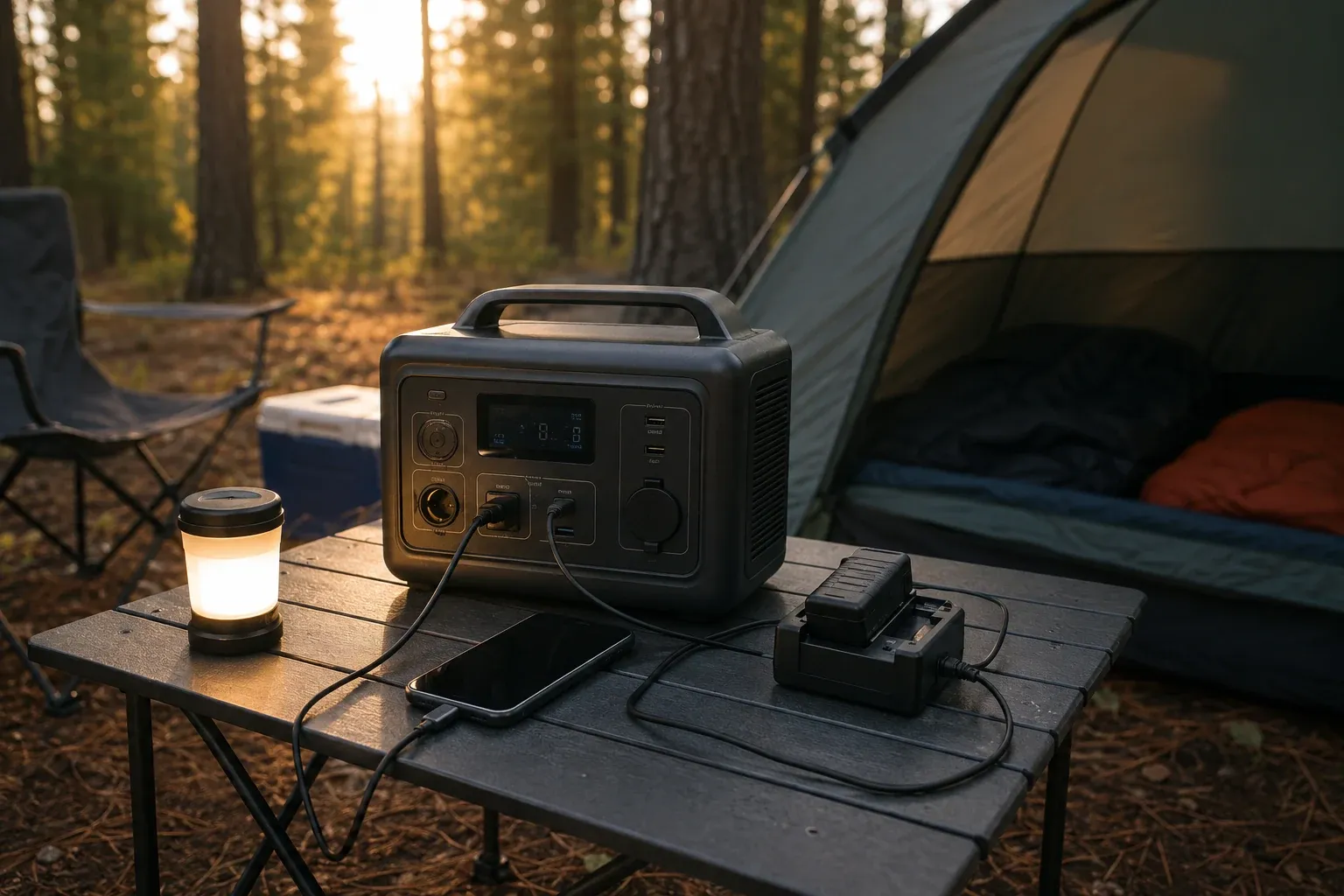
For most campers, a 500 to 1,000Wh power station is the sweet spot — enough to run lights, charge phones and a camera, and keep a 12V cooler or a CPAP going through a weekend, without weighing more than you want to carry from the car. But “most campers” hides a lot of range. The right size comes down to three things: what you actually power, how many nights you’re out, and how far you carry it. Here’s how to land on the number that fits your trips instead of the one the marketing pushes.
Start with what you actually power
Camping loads are not home loads. You’re not running a microwave or a hair dryer — you’re running small, mostly low-draw gear, and that changes the math entirely. A realistic camping kit and what each piece pulls over a day:
| Item | Power | Use/day | Energy/day |
|---|---|---|---|
| Phone charging (×2) | 18W each | 3 hrs | ~110 Wh |
| Headlamps / lantern (USB) | 10W | 4 hrs | ~40 Wh |
| Camera batteries | 30W | 2 hrs | ~60 Wh |
| CPAP (no humidifier) | 35W | 8 hrs | ~280 Wh |
| 12V cooler/fridge | 45W avg | 24 hrs | ~1,080 Wh |
| Small fan | 15W | 8 hrs | ~120 Wh |
| Laptop / tablet | 45W | 2 hrs | ~90 Wh |
Notice the gap. Phones, lights, and a camera together barely clear 200Wh a day. Add a CPAP and you’re near 500Wh. The one item that dominates everything is a 12V cooler running around the clock — on its own it can use more than all your other gear combined. Whether you bring a powered cooler is the single biggest factor in what size you need.
Three camper profiles
Most people fall into one of three patterns. Find yours, then match the capacity:
| Profile | What you run | Daily energy | Recommended size | Target weight |
|---|---|---|---|---|
| Minimalist | Phones, lights, camera | 150–250 Wh | 300–500 Wh | Under 12 lbs |
| Comfort | Above + CPAP + fan | 400–600 Wh | 500–1,000 Wh | 12–25 lbs |
| Car camping / family | Above + 12V cooler + occasional AC device | 1,200–1,800 Wh | 1,000–2,000 Wh | 25+ lbs (you drive to the site) |
The logic: match the station to about one to two nights of your daily draw if you’re not bringing solar, since you want margin for the trip that runs long. A Comfort camper using ~500Wh a night is well served by a 1,000Wh station — two nights of runtime with no recharge, or indefinite with a small panel.
The weight trade-off nobody mentions until they’re carrying it
Here’s where camping differs from home backup: you carry the thing. At home, a 60-pound power station sits in a closet and weight is irrelevant. At a campsite, every pound you packed is a pound you hauled from the car, and sometimes farther.
This is why bigger is not better for camping. A 2,000Wh station weighs 40 to 60 pounds — fine for car camping where it lives in the trunk, miserable for anything involving a walk to the site. The 1,000Wh class lands around 24 to 37 pounds depending on the model, and the lightest units in that class are the ones worth paying attention to. The Jackery Explorer 1000 v2, at 23.8 pounds, is the lightest LiFePO4 unit in its capacity class precisely because weight is the spec that matters most when you’re the one carrying it.
My rule: buy the smallest capacity that covers your trips, not the largest you can afford. You’ll use the extra capacity once and curse the extra weight every trip after.
Solar for trips that run long
Capacity answers “how many nights can I go without recharging.” Solar answers “what if the trip runs longer than planned.” For one or two nights, skip the panel — a fully charged station is simpler and lighter. For three nights or more, a 100 to 200W folding panel keeps the station topped up and removes the do-I-have-enough-left math from your evenings.
A 100W panel weighs about five pounds, folds flat behind a seat, and returns enough on a sunny day to cover a Minimalist or Comfort camper’s full daily draw. Match the panel to the station’s input the same way you would for any setup — the solar panel pairing guide covers the voltage details, and the RV solar setup guide walks through deploying panels in the field, which applies just as well at a campsite.
The most common sizing mistake
It’s over-buying. The marketing pushes 2,000Wh “for peace of mind,” and campers who do the math afterward realize they used 400Wh a night and carried a 50-pound box to do it. The fix is the load table above: add up what you actually run, multiply by nights, add a third for margin, and buy that — not double it.
The second mistake is the opposite: a 300Wh unit that can’t make it through a single night with a CPAP. If you run any continuous overnight load, start at 500Wh and size up from there.
Recommended sizes for camping
The right pick tracks your profile:
- Minimalist / weekend: a 500–1,000Wh unit. The Bluetti AC180 (1,152Wh) covers a comfort setup with margin and still pairs cleanly with a 200W panel.
- Lightweight priority: the Jackery Explorer 1000 v2 — the lightest LiFePO4 unit in its class at 23.8 lbs, the one to carry if you ever walk to your site.
- Value / higher solar input: the Anker SOLIX C1000 — similar capacity, the highest solar input in the class, usually the lowest price.
The camping section collects everything we publish for off-grid trips, and every figure here follows our testing methodology.
The short version
Add up what you actually power — for most campers that’s 150 to 600Wh a night, and a 12V cooler is the one thing that changes everything. Match a 500 to 1,000Wh station to your nightly draw with a third in reserve, prioritize the lightest unit in that class because you carry it, and add a 100–200W folding panel only if your trips run past two nights. Buy the smallest size that covers your trips, not the biggest you can justify.