
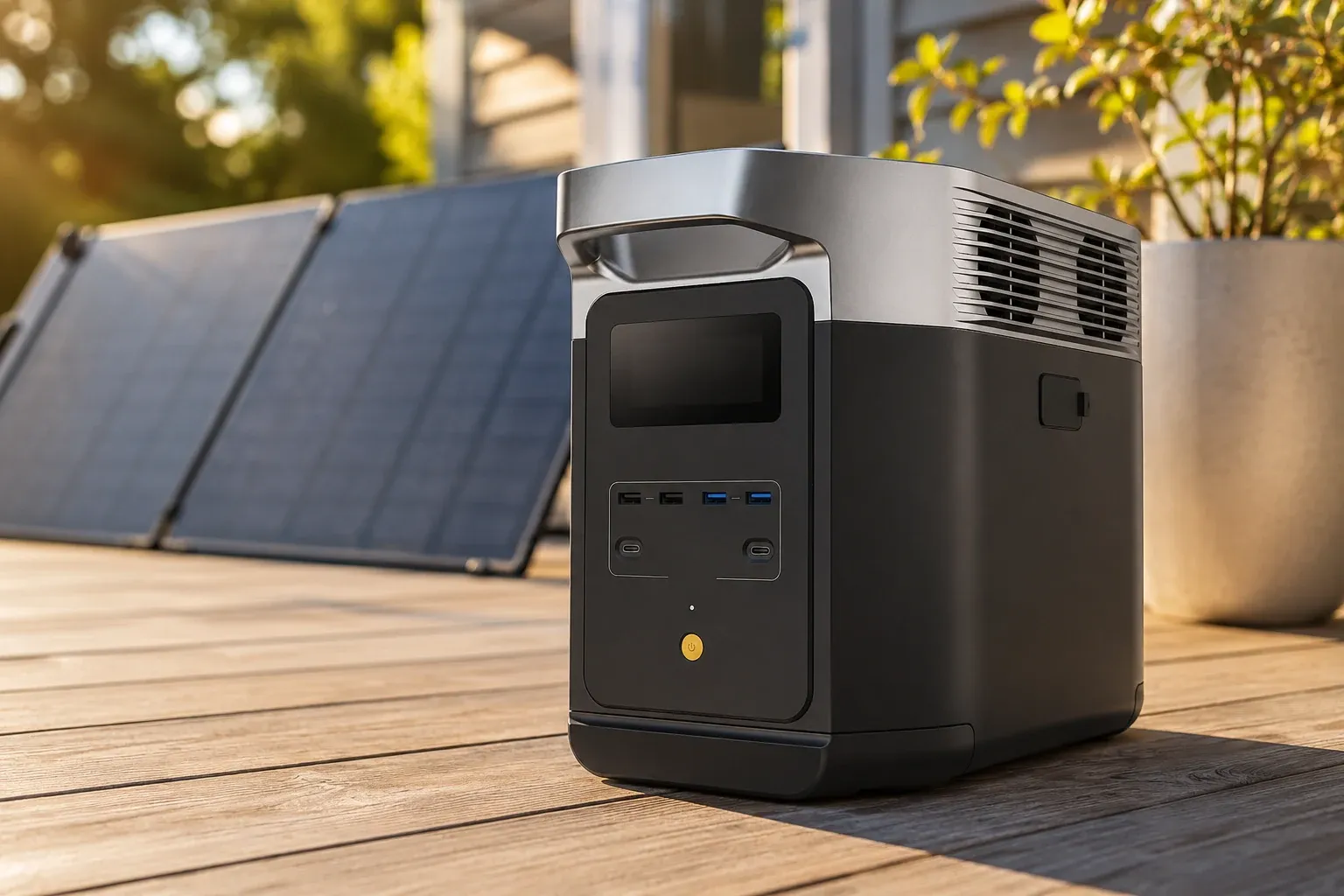
The 1,000Wh class is the most crowded, most competitive tier in portable power, and four LiFePO4 units define it: the Jackery Explorer 1000 v2, the Bluetti AC180, the Anker SOLIX C1000, and the EcoFlow Delta 2. They land within ten percent of each other on usable capacity, all carry five-year warranties, and all use the same battery chemistry. What separates them is philosophy — how each manufacturer chose to spend the available weight, inverter headroom, charge speed, and solar input. The Jackery spent it on weight. The Anker spent it on price. The Delta 2 spent it on flexibility: the fastest charging in the class, the most outlets, X-Boost, and an expansion path none of the others except the Anker can match. This review is about whether that flexibility is the flexibility you actually need.
Who this is for
The Delta 2 makes sense if at least two of these describe you:
- You want the option to grow your capacity later without rebuying. The Delta 2 starts at 1,024Wh and accepts an add-on battery to reach 2,048Wh, or the larger DELTA Max battery to reach 3,040Wh. You buy the base unit now and scale only if your needs change — a hedge the fixed Jackery and Bluetti units don’t offer.
- You recharge on a tight turnaround. The ~50-minutes-to-80% AC charge is the fastest in the class by a clear margin. If your pattern is “ran it down today, need it full tonight,” nothing here refills faster.
- You run a busy bench of devices at once. Six AC outlets plus a stack of USB and DC ports — fifteen outputs total — means a CPAP, a lamp, a laptop charger, a fan, and a phone bank all plug in directly. No power strip, no daisy-chaining.
- You value software. EcoFlow’s app is the most capable here: live drain and charge readouts, adjustable charge speed, scheduling, and remote on/off over Wi-Fi or Bluetooth. If you like to see and control what the unit is doing, this is the ecosystem.
Who should skip it
Step away from the Delta 2 if either is true:
- You need to run bigger appliances, not the same ones longer. This is the single most important thing to understand about the Delta 2, and I’ll spend a full section on it below: the expansion battery adds capacity but not inverter power. If your problem is a 2,000W load the 1,800W inverter won’t carry, no number of extra batteries fixes it — you need a bigger inverter, which means the EcoFlow Delta 2 Max or the 2,000Wh class.
- You’ll run the unit near where you sleep under heavy load. The Delta 2’s fan is the most audible in this group when it’s working hard — noticeably louder than the Jackery 1000 v2 or the near-silent Bluetti AC180. Under light loads it’s fine; under a sustained 800W-plus draw it makes itself known.
What changed from the original DELTA — and why it matters
The original EcoFlow DELTA used NMC (lithium nickel manganese cobalt) cells rated for roughly 500 to 800 full cycles to 80% capacity. The Delta 2 switched to LiFePO4 rated for 3,000 cycles to the same threshold — a four-to-six-fold increase in cell lifespan, and the change that moved the Delta 2 from “a unit you replace in a few years” to “a unit that outlives its own inverter.”
In practice, at one full cycle per week, the LiFePO4 pack is good for well over a decade before capacity slips below 80%, and the fan, MPPT controller, or inverter will fail long before the cells do. The chemistry switch effectively removes battery degradation from the buying decision — the same conclusion that applies to every LiFePO4 unit in this class. The tradeoff that came with it is shared, too: LiFePO4 refuses charge below freezing, which I cover in the cold-weather section.
The expansion question — capacity is not power
Most reviews treat the Delta 2’s expandability as an unqualified win. It isn’t. It’s a genuinely useful feature that is also widely misunderstood, and getting it wrong is the most expensive mistake a Delta 2 buyer can make.
Here is the mechanism. The Delta 2’s inverter — the component that converts stored DC energy into the AC power your appliances use — is rated at 1,800W continuous, 2,700W surge. Attaching an expansion battery raises the energy reservoir from 1,024Wh to 2,048Wh or 3,040Wh, but it does not touch the inverter. The unit can store more, and therefore run a given load longer, but it cannot run a bigger load. A 1,900W appliance that trips the inverter at 1,024Wh trips it at 3,040Wh just the same.
That distinction sorts buyers cleanly:
- Expansion is the right call if you already own the Delta 2 and find you want more runtime — more nights off-grid, a longer outage margin — for the same set of devices you already run. The add-on battery is the cheapest way to get there, and you keep the app and charging you already know.
- Expansion is the wrong call if you’re buying fresh and you already know you want around 2,000Wh. Two reasons. First, a base Delta 2 plus its expansion battery often costs close to what a native 2,000Wh unit costs — and the native unit gives you a stronger inverter in the bargain. The Delta 2 Max is 2,048Wh with a 2,400W inverter; the Jackery Explorer 2000 v2 is 2,042Wh with a 2,200W inverter and a 4,400W surge. Either runs loads the expanded Delta 2 cannot. Second, an expanded Delta 2 is two boxes to store, move, and cable together; a native 2kWh unit is one.
The honest summary: buy the Delta 2 for what it is — a 1,024Wh unit with a 1,800W inverter — and treat expansion as insurance against needing more runtime later, not as a path to more power. If you need more power, buy up front.
Real capacity — what 1,024Wh means in practice
The 1,024Wh on the spec sheet is the cell-pack capacity. The number that matters for planning is the usable energy at the AC outlets after the inverter’s conversion losses. For LiFePO4 units in this class, inverter efficiency runs about 84% to 88%, which puts usable AC capacity at roughly 860 to 900Wh. Loads on the 12V output skip the inverter and lose only 5% to 8% in the buck converter, leaving closer to 950Wh.
Concrete runtime on common loads, from a full charge at room temperature:
| Load | Power | Output | Runtime |
|---|---|---|---|
| CPAP without humidifier | 35W | AC | ~25 hours |
| 12V camp fridge | 45W avg | 12V | ~21 hours |
| Mini fridge (cycling) | 90W avg | AC | ~9–10 hours |
| 65W USB-C laptop | 65W | USB-C | ~14 hours |
| Phone charging | 18W | USB-C | ~48 hrs charging |
| LED string lights | 12W | AC | ~72 hours |
| 700W microwave | 700W | AC | ~72 minutes |
| 900W coffee maker | 900W | AC | ~58 minutes |
| 1,500W space heater (low) | 1,000W | AC | ~52 minutes |
Two takeaways. On small continuous loads — the CPAP-and-lights overnight profile, or a camp fridge — the Delta 2 is generous and lasts well past a single night. On high-wattage resistive loads, runtime collapses by physics, not by EcoFlow’s design: any 1,024Wh unit asked to deliver 900W is empty in under an hour. That is the ceiling the expansion battery is built to raise — and the only thing it raises.
Recharge — the Delta 2’s strongest hand
AC charging is where the Delta 2 simply wins the class. Using EcoFlow’s X-Stream charging from a standard wall outlet:
- 0% to 80% in roughly 50 minutes
- 80% to 100% in another 30 minutes (the BMS throttles the top of the curve to protect the cells)
- Full charge in about 80 minutes
That is meaningfully faster than the Jackery Explorer 1000 v2 (~1.7 hours) and the Bluetti AC180 (~1.8 hours), and competitive with the fast-charging Anker SOLIX C1000. For home backup specifically — where storms travel in bands and you want the unit topped up before the next hit — that recharge speed is worth more than it looks on paper. A useful detail: you can dial the charge rate down in the app, which cuts fan noise and heat when you’re recharging overnight and don’t need the speed.
Solar recharge tops out at 500W (11–60V MPPT), the same ceiling as the Bluetti AC180 and above the Jackery’s 400W, though below the Anker’s 600W. A 400W foldable array refills the unit from 20% in about six to seven hours of good mid-day sun. The 12V car port delivers around 100 to 130W — enough that a few hours of highway driving makes a real dent. For matching panels to the unit’s input window, see our solar panel pairing guide.
The inverter, X-Boost, and surge behavior
The 1,800W continuous / 2,700W surge inverter handles the loads it’s sized for without drama. A residential refrigerator compressor pulls 1,000 to 1,800W for the first half-second of startup before settling to 100 to 200W; the 2,700W surge absorbs that cleanly. Sump pumps and small power tools sit in the same envelope.
Where the Delta 2 separates itself from the Jackery is X-Boost. The Jackery’s 1,500W inverter is a hard ceiling — exceed it and the unit shuts off. EcoFlow’s X-Boost instead reduces voltage to keep certain resistive loads running up to 2,200W at reduced effective power. A 2,000W hair dryer or a 2,000W kettle that would trip the Jackery will run on the Delta 2 in X-Boost mode, slower but functional. The caveat is that X-Boost works only on resistive loads (heaters, kettles, hair dryers) — it does nothing for motor-driven or electronic loads, and it can’t be used for anything voltage-sensitive. Within its lane, though, it’s a real, usable advantage in a kitchen or workshop.
Build, ports, noise
The case is impact-resistant plastic with molded side handles — no fold-down bar like the Jackery, which makes the 27-pound Delta 2 a two-handed carry rather than a one-hand grab. The display is a clear backlit LCD showing input watts, output watts, state of charge, and a runtime estimate at a glance.
Port layout is the most generous in the class — EcoFlow advertises fifteen outputs, and the practical layout is:
- 6 × AC outlets (1,800W combined, pure sine wave)
- 2 × USB-C (100W PD)
- 4 × USB-A (two standard, two fast-charge)
- 1 × 12V car port (regulated, ~126W)
- 2 × DC5521 outputs
Six AC outlets is the standout. For home backup, where you might want a fridge, a modem, a router, a couple of lamps, and a phone charger all live at once, the Delta 2 covers it without a power strip — something none of the three- and four-outlet rivals manage.
Noise is the Delta 2’s weakest point. Under a 50% rated AC load the fan sits around 53 dB at one meter — audible across a quiet room, and noticeably louder than the Jackery 1000 v2 (~45 dB) or the Bluetti AC180 at idle. Under light loads the fan is quiet or off, and dialing back the charge rate in the app keeps it calm during recharge. But if you plan to run sustained heavy loads near a bedroom, this is the unit in the class you’ll hear.
Cold-weather behavior
Like every LiFePO4 unit here, the Delta 2 stops accepting a charge below 32°F (0°C) to protect the cells, and degrades faster sustained above 113°F (45°C). It has no integrated low-temperature heater, so a unit that cold-soaks overnight in a freezing vehicle won’t begin solar charging until the cells warm to operating temperature — typically by mid-morning under direct sun.
Discharge in the cold is more forgiving: the Delta 2 delivers usable power down to about 0°F, with available capacity dropping 10% to 20% as temperatures fall. The practical guidance is the same as for the rest of the class — keep the unit inside the rig or the house overnight rather than in an external compartment, and expect slower morning solar recharge after a freezing night.
How it compares
The Delta 2 lives in the tightest neighborhood in portable power. Four LiFePO4 units, all within roughly ten percent of each other on the headline specs, all on five-year warranties. The differences are quiet but they decide the purchase.
| Spec | EcoFlow Delta 2 | Jackery 1000 v2 | Bluetti AC180 | Anker SOLIX C1000 |
|---|---|---|---|---|
| Capacity (Wh) | 1,024 | 1,070 | 1,152 | 1,056 |
| Continuous inverter | 1,800W | 1,500W | 1,800W | 1,800W |
| Surge | 2,700W | 3,000W | 2,700W | 2,400W |
| AC charge to 100% | ~80 min | ~1.7 hrs | ~1.8 hrs | ~58 min |
| Solar input max | 500W | 400W | 500W | 600W |
| Weight | 27 lbs | 23.8 lbs | 37 lbs | 28.4 lbs |
| AC outlets | 6 | 3 | 4 | 4 |
| Expansion battery | Yes (3,040Wh) | No | No | Yes (2,112Wh) |
Buy the EcoFlow Delta 2 if flexibility is your priority — fast recharge, the most outlets, X-Boost for resistive loads, and a real expansion path. It’s the most versatile unit here.
Buy the Jackery Explorer 1000 v2 if weight is in your top three criteria. At 23.8 pounds it’s the easiest to carry, and its 3,000W surge is the strongest in the class. Our Jackery Explorer 1000 v2 review covers the case in full.
Buy the Bluetti AC180 if you want the most capacity and a near-silent fan, and you accept the 37-pound weight — a strong fit for stationary home backup.
Buy the Anker SOLIX C1000 if price is the primary filter. It’s consistently the cheapest, charges nearly as fast, and has the highest solar input. The 2,400W surge is the only meaningful give-up.
Final verdict
The EcoFlow Delta 2 is the right unit for the buyer who values flexibility over any single spec. It charges faster than anything in the class, carries more outlets than anything in the class, runs resistive loads its rivals can’t via X-Boost, and offers an expansion path for the days your needs grow. For a versatile do-everything unit that lives across camping, RV trips, and short home outages, it’s the most adaptable choice here — and the app makes it the most pleasant to actually live with.
The two things to keep clear-eyed about are the fan, which is the loudest in the group under load, and the expansion battery, which buys you runtime and not power. Understand that the 1,800W inverter is the ceiling no add-on battery raises, size your expectations to it, and the Delta 2 rewards you with the most flexible 1,000Wh unit on the market. Need more than essentials or bigger appliances? Step up to the 2,000Wh class — our best solar power generators roundup maps the options. Every figure here follows our testing methodology.